


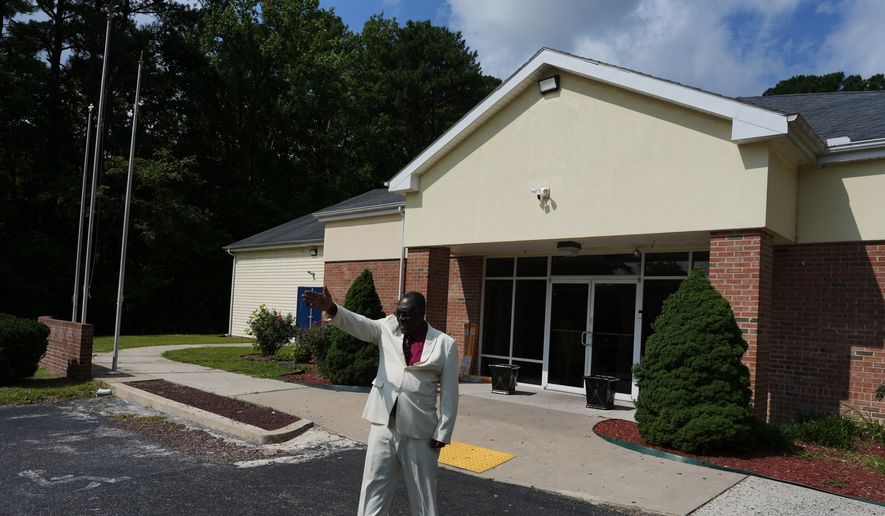

A Trump Homeland Security policy allowing ICE more freedom to make warrantless arrests at houses of worship tramples on the religious rights of migrants, churches, temples and mosques, a federal appeals court ruled Tuesday.
The 4th U.S. Circuit Court of Appeals said churches proved that they were likely losing congregants because of the DHS policy.
The three-judge panel, in a unanimous decision, also said the more aggressive arrest approach placed a burden on the exercise of religion — a burden the government didn’t adequately justify.
That puts the government in violation of the Religious Freedom Restoration Act, the court ruled.
“The present record is replete with evidence that the 2025 policy has caused a reduction in attendance at the plaintiffs’ houses of worship,” wrote Judge Barbara Keenan, an Obama appointee. “Such a burden, even if limited in time, constitutes irreparable injury.”
The policy, issued in the early days of the Trump administration, allows U.S. Immigration and Customs Enforcement officers to make arrests at sensitive locations based on their “common sense.”
It overturned a Biden-era policy that had generally discouraged those arrests and had required approval from ICE headquarters in all but the most urgent cases.
The Biden definition of sensitive locations went far beyond houses of worship, to include schools and bus stops, courthouses, playgrounds and community centers. The areas around those sites were also restricted.
Several court challenges were filed, with the ones by religious denominations proving particularly successful.
That’s because RFRA, the 1993 law, creates a high bar for the government to clear when its actions interplay with religion.
The case before the appeals court was led by Quaker organizations along the Atlantic seaboard and was joined by the Sikh Temple Sacramento and the Cooperative Baptist Fellowship.
The Trump administration argued to the court that those groups lacked legal standing to sue.
But the court said they had adequately proved their congregations dwindled after DHS announced the policy change last year.
And for Quakers, the mere possibility of a law enforcement officer carrying a gun into a meeting could upend a worship service, the court said.
That isn’t the end of the legal story. The government could still prove that the burden was justified.
However, the Justice Department didn’t make that defense in the lower court, so the appeals court said the government waived that argument.
Judge Steven Agee, a George W. Bush pick who was part of Tuesday’s 3-0 ruling, called that an “inexplicable failure” on the part of the government.
“In short, DHS abdicated its burden of proof at a crucial juncture of the merits analysis,” he wrote.
Judge Agee said the ruling applies only to houses of worship, not other sensitive locations, and only to the plaintiffs in the case.
And he said arrests are still possible in exigent circumstances, or when agents already have an arrest warrant.
Contact the author

Please read our comment policy before commenting.