



A version of this story appeared in the daily Threat Status newsletter from The Washington Times. Click here to receive Threat Status delivered directly to your inbox each weekday.
Russia is doubling down on its military role in Africa despite the growing demands of its war in Ukraine, and the latest example features a direct intervention to help Niger’s military junta suppress a mutiny.
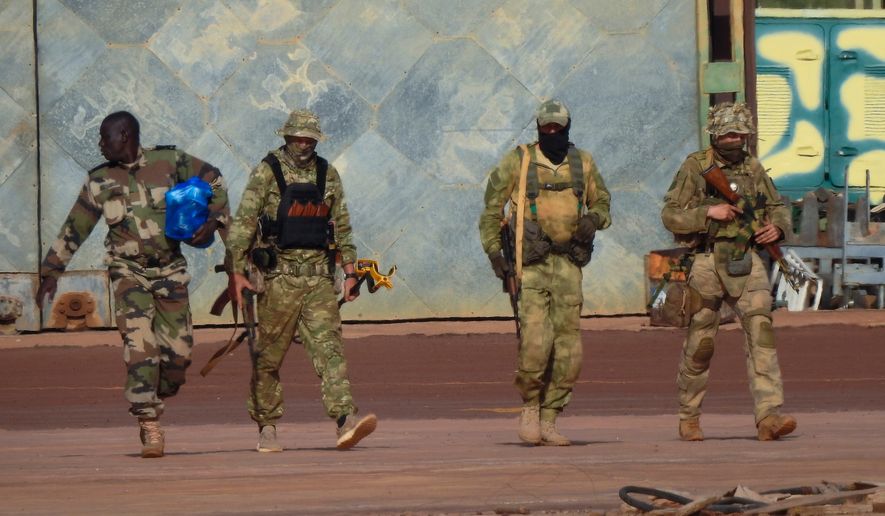
The intervention Saturday marked the second time this year that Russian troops have operated directly alongside forces of the ruling junta in Niger’s capital city of Niamey, underscoring Moscow’s role as security guarantor for the gold- and uranium-rich West African nation, which has been battling Islamist insurgents for more than a decade.
Niger, situated in Africa’s Sahel region, is home to significant uranium deposits, with roughly 6% of the world’s identified uranium reserves, according to the World Nuclear Association. The country was the source of some 25.4% of uranium delivered to European Union utilities before disruptions after the 2023 coup that installed the junta now holding sway in Niamey.
Russian diplomatic and military operations have risen in Niger during the years since and appear to have expanded in scope since 2024, when the Biden administration withdrew a key contingent of about 1,000 U.S. forces from bases in Niger, including the strategic drone base at Air Base 201 in Agadez and a separate facility in Niamey, at the request of the junta.
The withdrawal made global headlines and drew behind-the-scenes criticism from U.S. national security officials over the prospect of losing a strategic U.S. base that had been used for counterterrorism missions against regional extremists.
The latest developments point to a dynamic of growing complexity, with Russian forces now active in a conflict that intersects with great-power nuclear competition and increasingly involves forces from Algeria, which borders Niger to the north and is a close Russian partner in the Arab world.
On Saturday, a mutinous faction of young Niger military officers suddenly led a series of assaults across Niamey. Local sources say the group aimed to remove the country’s junta leader, President Abdourahamane Tiani, in a coup.
Mr. Tiani came to power on July 26, 2023, after overthrowing the democratically elected government.
Junta forces loyal to Mr. Tiani, aided by Russian military intervention that included ground forces and aerial assets, resisted the mutiny and tipped the balance in favor of the loyalists, who ultimately crushed the mutiny.
“This incident proved to the government that Russia remains a reliable security partner not just in regard to terrorist threats but internal security as well,” a Niger counterterrorism expert told The Washington Times on the condition of anonymity from Niamey.
Algeria, which has traditionally been reluctant to involve its combat forces in the messy politics of sub-Saharan Africa, is increasingly engaging in Niger. It announced last month that it had donated two Mi-24V attack helicopters and two Mi-171 transport helicopters to the junta.
Algeria then made the unprecedented move of deploying four Su-30MKA fighter jets and an Il-78 aerial refueling tanker to Niger in response to the Saturday mutiny — the first known overseas deployment of Algerian combat aircraft.
It was not clear under which mandate the Algerian forces were deployed. The Algerian Constitution requires a two-thirds parliamentary approval for the president to deploy forces abroad.
Strategic airport
Friction within Niger’s junta has centered around a military facility adjacent to Niamey airport, which once housed U.S. forces.
The airport is also home to a large shipment of uranium at the center of a separate dispute between the junta and the French government.
Some 1,150 tons of yellowcake uranium worth about $200 million are believed to be stored at the airport.
“National troops repelled these attacks with the assistance of the Russian Ministry of Defense’s African Corps,” the Russian Foreign Ministry said in a statement Sunday.
The ministry also accused “former European colonial powers” of inciting extremist violence in the region, an apparent allusion to France.
Russia’s Africa Corps is a Russian Defense Ministry-controlled expeditionary force that the Kremlin established in late 2023 to replace the mercenary Wagner Group, which Moscow struggled to control. The Africa Corps was stood up after Wagner founder Yevgeny Prigozhin’s 2023 mutiny and subsequent death.
The Africa Corps troops burst into action in Niger on Jan. 29 to help defend the airport in Niamey during an attack by Islamic State extremists from the ISIS-Sahel group.
Diori Hamani International Airport is home to the logistics, command and advisory hub in Niger for Russia’s Africa Corps.
Few sites better encapsulate the region’s geopolitics than Base 101 at the airport. The strategically important complex, which once hosted American troops, now houses a Russian base. It is also home to the joint command of the Alliance of Sahel States, a regional bloc comprising the pro-Russian, military-led governments of Niger, Mali and Burkina Faso.
The airport has been the scene of three battles this year, two featuring attacks by ISIS-Sahel and al Qaeda-linked militants, and the third stemming from the junta mutiny.
“With Russian help, the situation has been brought somewhat under control,” said Adal Rhoubeid, a former adviser to Mohamed Bazoum, who served as Niger’s democratically elected president before he was overthrown and detained by the military in 2023.
“But the causes of the instability are still there. The army is unable to fight efficiently against the terrorist groups, and the current regime struggles to deliver economic results for the people,” Mr. Rhoubeid said.
Russia’s presence in the country appears to have been directly targeted by the mutineers. A New York Times report quoting an unidentified Niger diplomat said Russian troops were briefly held hostage by the mutineers.
Russian newspaper Kommersant reported that the forces carrying out the mutiny also attempted to enter the Bravia Hotel in Niamey, where Russian Embassy staff and lawmakers attending an Alliance of Sahel States gathering were staying.
The uranium factor
Niamey’s airport also holds roughly 1,150 tons of yellowcake, a uranium concentrate used in the production of nuclear energy.
Niger moved the uranium from the Somair mine after Niger’s junta nationalized what had been a French-controlled mining operation, although France’s state-backed nuclear fuel multinational corporation, Orano, still claims rights to the stockpile.
The French newspaper Le Monde has reported that Russia’s state-owned atomic energy corporation, Rosatom, had planned to purchase and transport at least part of the uranium stockpile overland through areas of Burkina Faso threatened by Islamist militants to the Togolese port of Lome.
However, French pressure has complicated the proposed shipment. Orano secured an international arbitration ruling last year barring Niger from transferring the uranium. More recently, Romania’s state-controlled nuclear producer, Nuclearelectrica, has reportedly expressed interest in purchasing part of the stockpile.
Concerns that Niger’s uranium could fall into the wrong hands are hardly new. In 2002, Nigerien President Mamadou Tandja requested American assistance to protect nuclear material, according to a declassified CIA report.
In the decades since, Niger has battled an Islamist insurgency, with violence spilling into the country from neighboring Mali, while jihadi groups exploit communal rivalries among ethnic Fulani, Tuareg, Daoussahak and other communities.
After seizing power in 2023, Mr. Tiani expelled French and American military contingents deployed to Niger for counterterrorism missions. He has since turned to Russia as his security partner of choice.
“The Russian presence ensures that Western involvement is reduced or removed altogether,” Mat Whatley, managing director of the security-training company Okapi Train FZCO and a former British army officer, told The Times.
“In time,” Mr. Whatley said, “Russia hopes to further benefit from its deployment to the Sahel countries through contracts for non-security matters, including infrastructure construction.
“In return for the deployment of a few thousand men with equipment, Russia gains access to vital raw materials and minerals, including gold and uranium, a permanent presence, training areas, money and influence.”

Please read our comment policy before commenting.