



President Trump met with Lebanese President Joseph Aoun on Tuesday to wind down fighting between Israel and Hezbollah and threatened to bomb Houthi rebels in Yemen if they enforce a blockade in the Red Sea.
Mr. Trump, speaking from the Oval Office, said the U.S. dealt with previous threats from the Houthis, an Iran-backed terrorist faction, and will act again if shipping is threatened.
“So far, it hasn’t happened. Might happen. But we take care of things,” Mr. Trump said. “If something like that happens, we take care of it. You know, we’ve done that with the Houthis before, and we haven’t heard from them in a while.”
Mr. Trump warned the Houthis not to upset oil traffic on a pivotal day for Middle East peace.
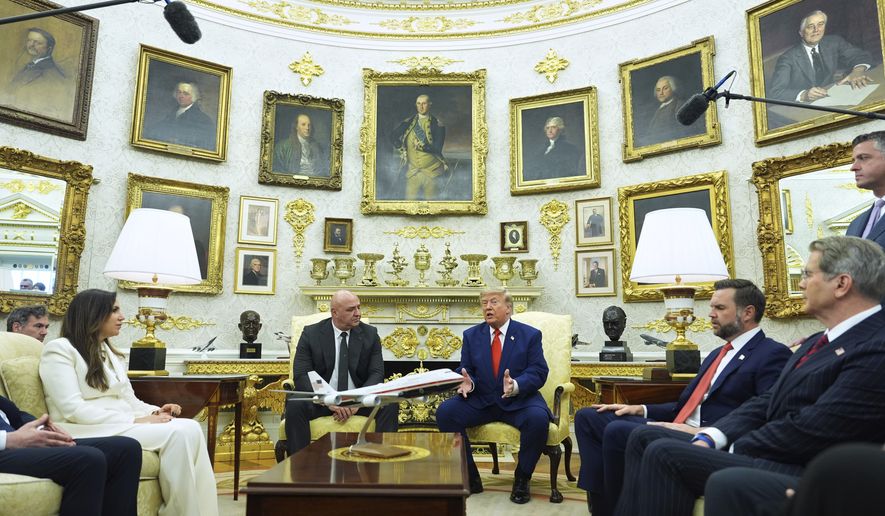
The president and Mr. Aoun are working to implement a June 26 framework agreement between Israel and Lebanon that called for a phased-in withdrawal of Israeli troops, who had deployed throughout Lebanon in response to Hezbollah attacks.
“They’re in the process of doing that. They’re in the process of redeploying,” Mr. Trump said of Israeli forces.
SEE ALSO: New fighting, blockade in Middle East threaten success of moves to stabilize oil markets
Under the deal, Israeli withdrawal from “pilot” areas must be accompanied by the disarmament of Hezbollah by the Lebanese armed forces.
The Lebanese leader thanked Mr. Trump for negotiating the framework with the “ultimate objective of ending the state of hostility between Israel and Lebanon forever.”
“This will be your legacy,” Mr. Aoun told Mr. Trump. “Together, we will be able to achieve this objective.”
Hezbollah is a Shiite terrorist group that acts as a political party and an Iran-backed proxy in Lebanon.
More than 4,000 Lebanese have been killed since fighting resumed on March 2, alongside the U.S.-Israeli war against Iran that began Feb. 28.
Fighting between Israel and Hezbollah has complicated the pursuit of a broader Middle East peace.
SEE ALSO: Hegseth facing questions from Congress about emergency spending package
Iran is upset about Israel’s assault and says its withdrawal from Lebanon must be part of a broader deal.
While Mr. Trump tried to corral the Hezbollah problem, the Iran-backed Houthis created a separate headache by threatening key shipping lanes that serve as an alternative to the contested Strait of Hormuz between Iran and the Arabian Peninsula.
The Houthis occupy much of Yemen’s southwestern territory and maintain effective control over the Bab al-Mandeb Strait, a choke point in the southern part of the Red Sea.
The Houthis previously announced a blockade in the Red Sea in response to Israel’s offensive in the Gaza Strip after the Oct. 7, 2023, terrorist attacks. The U.S. launched retaliatory strikes in Yemen to stop that blockade and reached an agreement with Houthi leaders to halt their attacks on U.S. vessels.
The Houthis have not enacted their latest announced plans, but their threat seems to be having an impact. Shipping trackers reported that at least two tankers made U-turns near the Bab al-Mandeb choke point before aiming for the Suez Canal to the north.
U.S. attacks on Houthi strongholds in Yemen would mark a major expansion of the Iran war, which has devastated the Middle East since Feb. 28. In addition to Israel, Persian Gulf states such as the United Arab Emirates, Saudi Arabia, Kuwait, Bahrain and Qatar have been hit by Iranian missiles and drones since the war began.
Iraq, Jordan and Syria have also come under fire from Iran for hosting U.S. military assets, which Iranian officials assert are legitimate targets in the war.
The Kuwaiti Foreign Affairs Ministry said it summoned Iran’s ambassador to protest Iranian attacks late Monday on a Kuwaiti tanker, the Kifan, while the ship transited the Strait of Hormuz.
Several crew members were injured, the ministry said.
Mr. Trump projected confidence Tuesday despite myriad challenges in the Middle East. He said Iran is “getting decimated” and faces pressure to cut a peace deal.
“They want to desperately meet. Until they’re ready to meet in a meaningful way, we have no interest [in meeting],” Mr. Trump said. “We are doing very well. We are degrading them at levels that nobody thought was possible. They’re being degraded really so seriously.”
The Feb. 28 assault on Iran killed top Iranian leaders and destroyed a swath of Iran’s military infrastructure.
Tehran retaliated by constraining oil traffic in the Strait of Hormuz, disrupting energy markets and causing headaches for shipping companies.
“The costs of this war have been astronomical,” Sen. Patty Murray, Washington Democrat and vice chair of the Senate Appropriations Committee, said at a supplemental funding hearing Tuesday with Defense Secretary Pete Hegseth. “And what has it been for? What has actually been achieved?”
Mr. Hegseth said the war with Iran has cost American taxpayers $37.5 billion so far, but he warned that failing to “properly” fund the Pentagon was “probably the single greatest threat that our nation faces.”
Mr. Hegseth and Gen. Dan Caine, chairman of the Joint Chiefs of Staff, testified in support of the White House’s request for $67.1 billion in new defense spending as part of an $87.6 billion overall emergency supplemental package. The extra money is intended to cover immediate military gaps while Congress debates the $1.5 trillion defense budget proposed for the next fiscal year.
“President Trump is following a simple logic: The military requires a generational investment to deliver on peace through strength. We know the best way to create peace is to prepare for war to deter it,” Mr. Hegseth said. “That’s exactly what the Department of War is doing, building a force so capable that it would be absurd for anyone to challenge it.”
The secretary made it through less than a minute of his Senate testimony before it was interrupted by several anti-war demonstrators, who were removed from the hearing room.
Mr. Trump says economic costs from the war will be worth preventing Iran from getting a nuclear weapon. He said he can also weather the midterm election season political pressure.
“I’m just going to do the right thing,” he said. “I don’t view it as, ’Gee, we’re having an election in a period of time.’”
Mr. Trump strongly hinted that the U.S. would be striking an underground nuclear facility that U.S. officials have called Pickaxe Mountain.
“We’ll be hitting that area very probably pretty soon,” Mr. Trump said. “There’s not a thing they can do about it. You know, normally I wouldn’t say that. If I thought they could do something about it, I would never say that. But we’ll be hitting that area pretty soon, and very heavily.”
Also Tuesday, the Pentagon identified the soldier killed in Iraq during a controlled detonation of a downed Iranian drone as Sgt. Michael Emmanuel Swinton, 30, of Fayetteville, North Carolina.
Defense Department officials said Sgt. Swinton was killed Sunday while “supporting overseas contingency operations” at Irbil Air Base in Iraq’s Kurdistan region.
“The incident is under investigation,” Pentagon officials said.
The base and the nearby U.S. Consulate have been the targets of multiple drone attacks by Iran and its militia factions. The base serves as the central operational hub for U.S. personnel in northern Iraq.
Sgt. Swinton was assigned to the 2nd Battalion, 55th Air Defense Artillery Regiment at Fort Bragg, North Carolina, when he deployed to Iraq.
Two other U.S. soldiers — 1st Lt. Tyler James Feehan, 25, of Ewa Beach, Hawaii, and Pvt. Isabella Gonzales, 19, of Carrollton, Texas — were killed by Iranian strikes in Jordan over the weekend.
Mr. Trump said he planned to travel to Delaware this week to attend the dignified transfer of the soldiers’ remains at Dover Air Force Base.
“We’re going to be going and paying our respects in Dover,” Mr. Trump said Tuesday.
• Mike Glenn contributed to this report.
Contact the author



Please read our comment policy before commenting.