



OPINION:
President Trump’s visit to China next week will be the first visit by a U.S. president since his first trip in November 2017. Trade and economic relations will top the meeting agenda, as will the war with Iran, the future of Taiwan and continued U.S. support for Taipei.
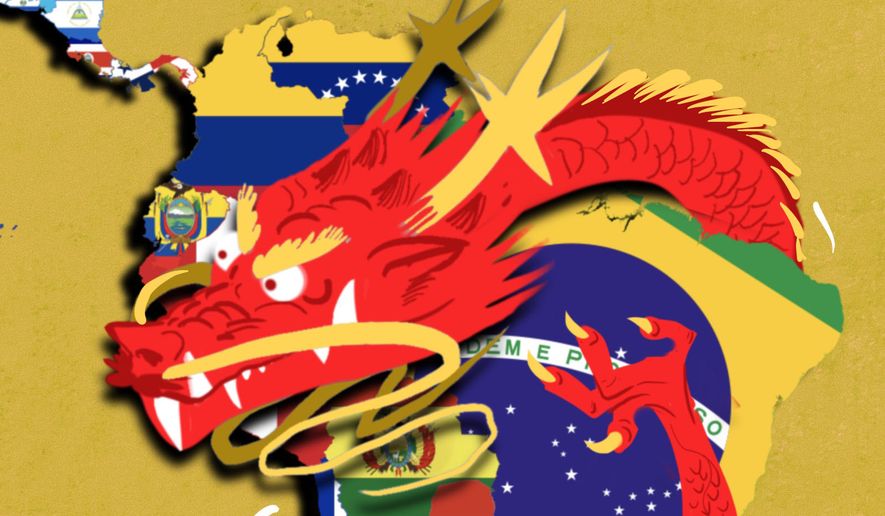
Still, one matter needs particular and urgent attention: China’s increasing infiltration of the Americas and the national security threat it poses.
Under the Biden administration, U.S. policy toward Latin America suffered from strategic malpractice as America’s adversaries — Iran, Cuba, Venezuela and China — gained or enhanced their footholds in the Western Hemisphere.
Mr. Trump’s reinvigorated U.S.-Latin America policy has effectively taken out the first three of these. Only China remains.
China’s silent invasion of the Americas is ongoing, deliberate and strategic. Trade and commerce have moved to sophisticated financial investments, the infiltration of critical infrastructure, and the establishment of strategic outposts that directly challenge U.S. influence and regional stability.
Almost two dozen Latin American countries have signed on to China’s Belt and Road initiative investment regime. Beijing has constructed a parallel financial architecture in Latin America that appears to be immune to Western leverage and is designed to create long-term, structural dependency.
It is characterized by opaque lending and the use of multilateral funds as instruments of statecraft.
Many Chinese loans to Latin America and the Caribbean are now commodity-backed, primarily in crude oil from Venezuela and Ecuador, mining in Nicaragua, Chile and Peru and agricultural products from Brazil. China controls some 8.5% of Nicaraguan territory through its mining concessions, while Venezuela remains permanently indebted to Beijing. This ensures a steady flow of heavy crude oil to China.
China’s focus has shifted from traditional infrastructure loans to high-tech and digital domains, providing capital necessary to install Chinese-controlled artificial intelligence, 5G and smart grid technologies throughout the region. This financial leverage creates technological dependency and embeds Chinese influence.
In Brazil, local relationships often include direct investment in telecommunications and surveillance command centers that bypass national security screening. In some Brazilian states, Chinese firms have secured contracts for 5G nodes and facial recognition systems directly integrated into local police departments.
In Argentina, despite the pro-U.S. Javier Milei administration, provinces continue to maintain independent technical cooperation agreements with Chinese state-owned enterprises. These agreements provide legal cover for the Espacio Lejano space station in Neuquen province and for Chinese interests in the proposed Ushuaia logistics hub, a gateway to the Antarctic.
These two major projects in southern Argentina will flank the Americas from the South Atlantic and from space. The effect has been to create extraterritorial Chinese zones that the federal government struggles to oversee.
The Espacio Lejano space station, operated by elements of the People’s Liberation Army, is a strategic outpost on Argentine soil capable of tracking U.S. and allied satellites and providing telemetry for Chinese hypersonic glide vehicles.
This facility, operating with extraterritorial privileges, gives Beijing a permanent intelligence, surveillance and reconnaissance platform over the Americas, directly compromising our space sovereignty.
China’s 2017 national intelligence law mandates that all Chinese firms cooperate with state intelligence. This means that data flowing through these networks, including diplomatic communications and commercial transactions, is potentially subject to interception by Chinese intelligence services, allowing Beijing to conduct real-time signals intelligence throughout the region.
Chinese-made high-voltage transformers and smart meters are increasingly being installed across the region, often equipped with telemetry modules that can monitor industrial power consumption and identify critical infrastructure nodes. Beijing could use this embedded capability to launch cyber-kinetic attacks, plunging regional capitals into darkness and disrupting U.S. logistical support.
Furthermore, Beijing is actively constructing a bypass that threatens to reroute global commerce and military logistics away from the Panama Canal, thereby undermining any U.S. strategic advantage.
A massive Twin Ocean Railway Connection, linking Peru and Brazil, is being planned despite environmental challenges. Bolivia has also expressed interest.
Heavy Chinese investment in the Chancay port project in Peru is an important example of this strategy. Chancay is the first deep-water port on South America’s Pacific coast capable of handling “Post-Panamax” vessels, thus bypassing the U.S.-controlled canal and establishing a Chinese-controlled Pacific gateway.
Beijing operates on a deliberate, long-term timeline devoid of democratic inconveniences. This strategic encroachment into Latin America is the greatest security challenge to the Americas in more than a century.
Hopefully, these serious security concerns will be delivered in person.
• Emilio T. Gonzalez is a retired U.S. intelligence officer who has served in senior positions in the U.S. Army, on the National Security Council and in the Department of Homeland Security.

Please read our comment policy before commenting.