


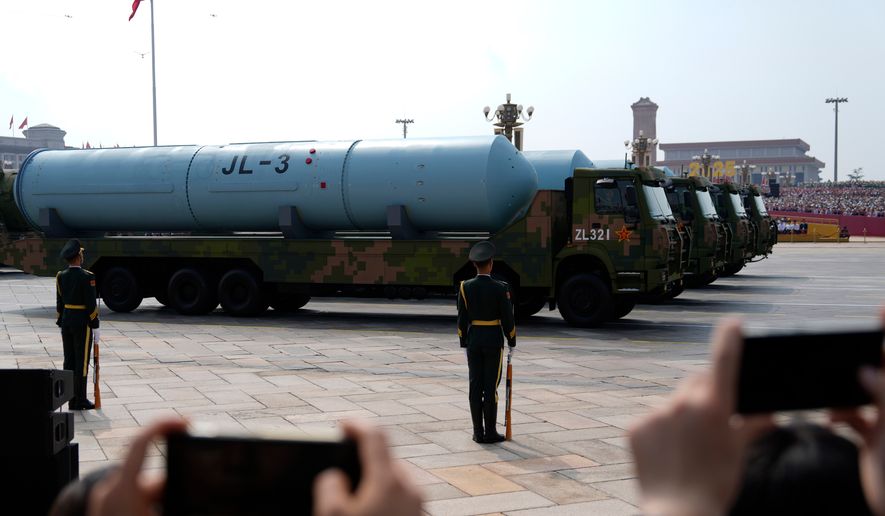

A version of this story appeared in the daily Threat Status newsletter from The Washington Times. Click here to receive Threat Status delivered directly to your inbox each weekday.
NEWS AND ANALYSIS:
China is building quieter submarines and other advanced undersea warfare capabilities that threaten a key American military advantage in deterring and fighting a future conflict over Taiwan, according to a new report by a congressional commission made public Wednesday.
China’s new capabilities include large numbers of more lethal and stealthy nuclear-powered attack submarines, new underwater strike drones, deep-sea sensors that can detect U.S. submarines and cable-cutting ships that can knock out vital internet connections to Taiwan, a key chapter of the report states.
The People’s Liberation Army also is applying artificial intelligence and quantum sensors to its underwater forces as part of its goal to sharply reduce the advantages of U.S. submarines — key weapons that the report said are needed for sinking large numbers of PLA troop transports in a potential invasion of the democratic-ruled island.
People were interested in these podcasts
The 705-page annual report from the bipartisan U.S.-China Economic and Security Review Commission provides extensive details on U.S. submarine warfare plans for deterring and defeating Chinese forces in a Taiwan war and how the PLA is gradually eroding a long-held U.S. advantage in submarine warfare.
The report is based on classified and unclassified briefings and testimony from senior admirals and other experts.
According to the report, in a PLA invasion of Taiwan, China will send tens of thousands of troops, trucks and tanks across about 110 miles of open water in the Taiwan Strait.
“Lurking beneath the surface would be one of the most potent threats to such an operation: nuclear-powered U.S. attack submarines,” the report said.
“As Chinese forces crossed the Strait, U.S. submarines could launch salvos of torpedoes and anti-ship missiles to ’wreak havoc’ on China’s invasion force,” the report said.
Until now, China’s relatively weak anti-submarine capabilities gave American submarines the most important military advantage in the Indo-Pacific and one that is key to deterring conflict, the report said.
A diagram in the report showed how a combination of PLA sensor networks and drones would be used in spotting submarines. They include satellites, smart buoys, wave gliders and robot surface vessels linked to land-based data fusion centers.
Underwater elements of the network include sea-bed sensors and two types of uncrewed underwater vehicles that were shown in the diagram detecting a Navy Virginia-class attack submarine.
“China’s most immediate undersea objective is not destroying U.S. submarines but rather making them easier to detect,” the report said.
Occasional detection of U.S. submarines near Taiwan and waters around Chinese coasts would force the Navy to change how submarines are routed and deployed, require new methods to hide, and “raise the risks of U.S. intervention in a Taiwan contingency,” the report said.
Instead of trying to match American submarine power, Beijing is pushing ahead with efforts to reduce the effectiveness of that power.
“Even partial success in strategically important waterways would expand operational risks, increase uncertainty, complicate U.S. operations and decision-making, and erode U.S. undersea military advantage,” the report said.
China has vowed to annex Taiwan with Chinese President Xi Jinping ordering the PLA to be set for military action in pursuit of that goal by 2027.
The commission said advanced PLA submarine warfare capabilities will require the Navy to alter its plans for a Taiwan conflict to “account for greater threats” to stealth and to develop new technologies and operational methods to counter the threats.
Vice Adm. Richard Seif, commander of Navy Submarine Forces, told the commission that even small increases in PLA submarine weapons, sensors, endurance and operational proficiency will alter the dynamics of underwater competition and require more resources needed to counter them.
Rear Adm. Michael Brookes, commander of the Office of Naval Intelligence, is quoted in the report as saying the PLA currently operates over 60 submarines and is shifting from diesel-electric to an all-nuclear force.
China’s most capable submarines are Shang III-class conventional missile submarines, each armed with 24 missile tubes for precision anti-ship or land attack cruise missiles.
Adm. Brookes said that number will increase to about 70 submarines by 2027 and expand to about 80 by 2035 with half of those nuclear-powered.
Trump to seek China role in nuclear arms talks
President Trump arrived in Shenzhen, China, on Wednesday for a meeting of leaders of the Asia Pacific Economic Cooperation forum where he plans to hold talks with Chinese President Xi Jinping and Russian President Vladimir Putin on nuclear weapons cuts.
A key goal for the president in Shenzhen will be to persuade China to join U.S. and Russian nuclear arms reduction talks.
“The president has made it clear that, among other topics, he will discuss the reduction of nuclear weapons in the world, whose proliferation President Trump believes is very dangerous,” White House spokeswoman Olivia Wales told reporters in a pre-APEC briefing.
A senior White House official said the president is not expecting to reach “any kind of agreement” at the summit.
“I would characterize this as the entry point, the first conversation, certainly at the leader level between these countries on how we can go about reducing the number of nuclear weapons,” the official said.
The U.S., Russia and China own most of the world’s nuclear weapons with China surging its warhead stockpiles as “the fastest in the world,” the official said, noting it is hoped initial discussions this week will produce more detailed talks later.
Asked about the prospects of China agreeing to such talks, the senior official said it remains “a difficult topic” for Beijing.
“But we do think it’s time for China to sort of step up to the adult table, if you will, and have adult conversations about adult things,” the official said. “They can’t just sort of, you know, [have a] ’take-their-ball-and-go-home’ type of attitude.”
China’s large-scale nuclear warhead and missile buildup is being carried out “very opaquely” and impacts the security of “every human being in the world,” the official said.
Russia has a much longer history, dating to the now defunct Soviet Union, of engaging in arms control talks and will probably be more comfortable in joining in what Mr. Trump hopes to initiate in Shenzhen.
Beijing officials for nearly a decade have turned down U.S. requests to join nuclear arms talks despite an obligation to engage in talks as a signatory of the Nuclear Nonproliferation Treaty.
China has said it would not join arms cut talks until U.S. and Russian warhead arsenals are reduced to China’s level.
Golden Dome leader warns missile danger grows
The U.S. military is building high-technology weapons and other capabilities to defend against rapidly growing advanced missile threats from China and Russia, including a hard to counter space-based attack system, according to the deputy director of the Golden Dome for America defense program.
Deputy Director Marcia Holmes warned in a speech that America is no longer protected by oceans and peaceful adjacent neighbors as in the past.
“Geography is no longer a safety net. If we want a shield today, we have to build it — across every domain, from the sea floor to low-Earth orbit,” Ms. Holmes said in a keynote speech to The Washington Times conference, “The Golden Age of Space.”
Current threats from Chinese and Russian missiles, aircraft and drones are “modernized, escalated and have become vastly more complex,” she said.
A major worry is China and its strategic nuclear force expanding at “breakneck” speed and doubling its warhead stockpile in record time, she said.
“And they are actively testing fractional orbital bombardment systems — FOBS,” she said.
This new space-based threat upended 50 years of strategic early warning systems that were focused on intercontinental ballistic missiles attacking over the North Pole, she said.
“A fractional orbital bombardment system can be launched into low-Earth orbit, fly over the South Pole, and strike the continental United States from the south, completely bypassing our legacy radar networks,” Ms. Holmes said.
China conducted a flight test of a FOBS missile in 2021 with a maneuvering hypersonic strike vehicle capable of defeating current missile defenses, the Defense Intelligence Agency stated in a report made public last month.
“This test demonstrated the greatest distance flown [about 24,855 miles] and longest flight time (~100+ minutes) of any Chinese land attack weapons system to date,” the report said.
DIA estimates China will have 60 FOBS by 2035 and stated that Russia could deploy 12 of its version of a FOBS by that date.
“As our near-peer adversaries field hypersonic gliders, orbital bombardment capabilities, and saturated salvos, we must prevent the erosion of a thin margin of defense,” she said. “We must maintain our war-fighting advantages and ability to protect and defend America.”
The Defense Department through Golden Dome is directing an urgent and direct mandate to close the homeland missile and aerial threat gap by leveraging cutting edge commercial and military technologies, she said.
The system will rapidly integrate existing sensors, communications networks and interceptors with new and advanced capabilities, she said.
“Building a layered, multidomain shield to protect and defend America is the answer to that mandate — Golden Dome for America,” Ms. Holmes said. “This shield is about defending our families, our power grids, our communications hubs, and the American way of life.”
Golden Dome will warn adversaries that any attack from the Pacific, from the Arctic, through all orbital lanes of space will be stopped by an integrated, layered, impenetrable shield powered by low-Earth orbit sensors, driven by AI-accelerated command and control, and backed by ready interceptors, she said.
The goal is to force adversaries, whether China, Russia or North Korea, to calculate that any attack on the U.S. homeland is mathematically futile.
“Because when an adversary knows an attack will fail, they will never launch it in the first place. That is how we protect our homeland,” Ms. Holmes said.
• Contact Bill Gertz on X @BillGertz.
Contact the author


Please read our comment policy before commenting.