


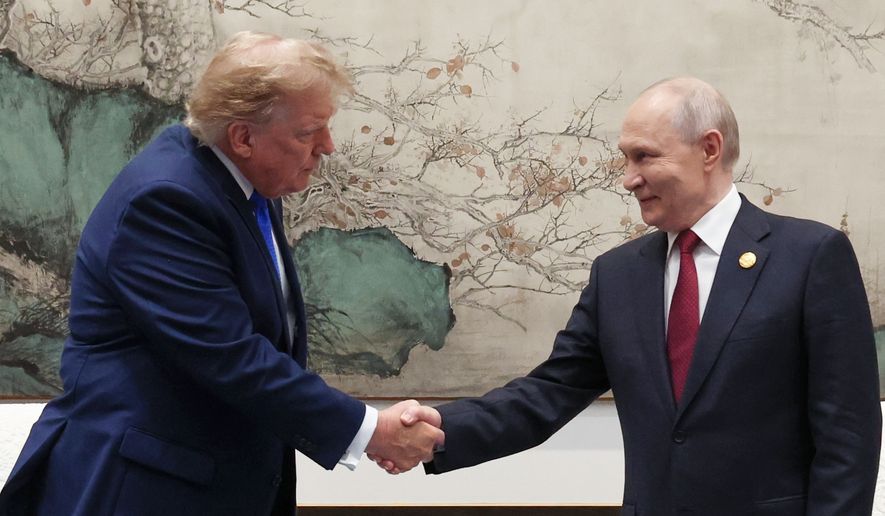

President Trump said Thursday he asked Vladimir Putin during their meeting in China earlier this month to halt Russia’s increasingly aggressive maneuvers across Europe and negotiate a comprehensive peace agreement on Ukraine.
In one of a flurry of Thanksgiving Day posts on Truth Social, Mr. Trump said he believes a peace deal between Ukraine and Russia is a “strong possibility” and drew attention to what he called a “complete bloodbath” in Eastern Europe.
Speaking with reporters later at Mar-a-Lago after a series of Thanksgiving calls to U.S. troops serving overseas, the president said the biggest obstacle to a deal is the distrust between Mr. Putin and Ukrainian President Volodymyr Zelenskyy.
People were interested in these podcasts
“It’s not easy when two leaders … hate each other,” he said.
Mr. Trump said he would welcome Mr. Putin to attend the 2026 G20 leaders’ summit, which will be held next month at his golf club in Doral, Florida, even though “some people wouldn’t like that.”
He said Mr. Putin was “very insulted” when Russia was kicked out of the G8 and that had he been president at the time he would not have voted to do so.
“I really believe strongly if they didn’t do that, we would not have that war going on right now,” Mr. Trump said.
The president’s comments came a day after his Wednesday meeting with NATO Secretary-General Mark Rutte at Mar-a-Lago, where the Russia-Ukraine conflict was the primary topic of discussion.
Mr. Trump briefed Mr. Rutte on his conversation with the Russian president in Shenzhen, China, earlier this month, where he also met Chinese President Xi Jinping in a historic trilateral format.
Mr. Rutte said ahead of the meeting that the Shenzhen summit was part of Mr. Trump’s efforts to test how seriously Mr. Putin takes peace talks.
“So let’s keep the pressure on. I think it is working, and we have to keep that going,” Mr. Rutte said in a Wednesday interview with “Fox & Friends.”
The two leaders also discussed the importance of eliminating options for Russia to expand its war with Ukraine and continued defense spending increases across the alliance.
The meeting came just hours before Russian ballistic missiles struck Kyiv and other regions of Ukraine. The strikes, which began late Wednesday and carried into Thursday morning, killed at least 10 people and wounded 58, according to Ukrainian authorities.
Ukrainian President Volodymyr Zelenskyy said Russia launched at least 113 drones at targets in six regions overnight. Emergency crews are still working to restore electricity for thousands of civilians.
Ukraine struck a Russian oil pipeline in Bashkortostan and a Russian oil refinery in Samara. Ukraine’s general staff said its overnight strikes hit an oil pumping facility and a military airfield. Russian authorities said their defenses intercepted 343 Ukrainian drones overnight across 15 regions.
At least five people were killed in another strike in the Russian-occupied Zaporizhzhia region, according to regional authorities.
Both Russia and Ukraine have intensified their attacks on critical energy infrastructure in recent days. Moscow has repeatedly targeted power grids, substations and overhead power lines in Kyiv and other heavily populated areas ahead of what is expected to be another brutal winter in Eastern Europe.
Kyiv, for its part, has increasingly targeted Russia’s oil infrastructure to limit Moscow’s energy profits.
Ukrainian intelligence indicates Russia is preparing to launch a new “massive strike” on vulnerable targets, Mr. Zelenskyy wrote on X on Thursday. He said Kyiv is pushing its allies, including the U.S., to provide more interceptor systems that could mitigate the damage from any future Russian missile and drone barrages.
The near-constant cross-border strikes come as the U.S. and Europe try to keep up diplomatic momentum and broker a peace agreement between Ukraine and Russia.
The U.S. mediated another round of trilateral talks with Ukrainian and Russian representatives earlier this month in Abu Dhabi, which Washington had hoped would move the needle on a future peace agreement. White House envoys Steve Witkoff and Jared Kushner pushed in particular for security guarantees for Ukraine.
But the only concrete result of the talks was an agreement for a future prisoner swap. Both sides also agreed in principle to hold further rounds of negotiations.
It was the first trilateral meeting since February, when further discussions were put on hold following the beginning of the U.S.-Israeli war with Iran.
The Abu Dhabi talks served as a prelude to Mr. Trump’s meeting with Mr. Putin in China, where European leaders had hoped he would maintain a hard line on security agreements for Ukraine.
Instead, EU officials, who convened in Berlin for a Coalition of the Willing meeting less than a day after the Shenzhen trilateral, were alarmed by Mr. Trump calling Mr. Putin his “friend.” Mr. Trump reportedly called into the coalition meeting to reassure members that Russia was serious about peace.
Other Trump administration officials have voiced similar sentiments recently. Mr. Kushner, who has met directly with Mr. Putin several times, told the “MD Meets” podcast this week that he believes the Russian leader wants peace, despite Russia’s repeated attacks and refusal to agree to a ceasefire.
“What we’ve seen, and this is not from his words, but from our interpretation of his words, is that he has very little confidence that if he stops the war, that he won’t be able to get to a post-war settlement that leads to not having a future war,” he said.
He added that he believes Mr. Putin has shown restraint by agreeing not to use nuclear weapons against Ukraine.
“Which obviously is a big thing, and he’s reassured us that’s not his intention,” Mr. Kushner added.
He also said he thinks Mr. Putin genuinely believes NATO’s expansion was a provocation and an existential threat to Russia.
While Mr. Kushner praised Ukraine and its conduct during the nearly five-year-long invasion, his comments about Mr. Putin aren’t likely to comfort Europe. Many of Kyiv’s allies, and Ukraine itself, view Russia’s actions during the war as provocative and reckless.
That apparent recklessness was on display this month when Russia violated Polish airspace twice, with a wayward drone and several cruise missiles. NATO jets were scrambled after the missiles were detected but did not fire because of poor weather conditions.
Contact the author


Please read our comment policy before commenting.