


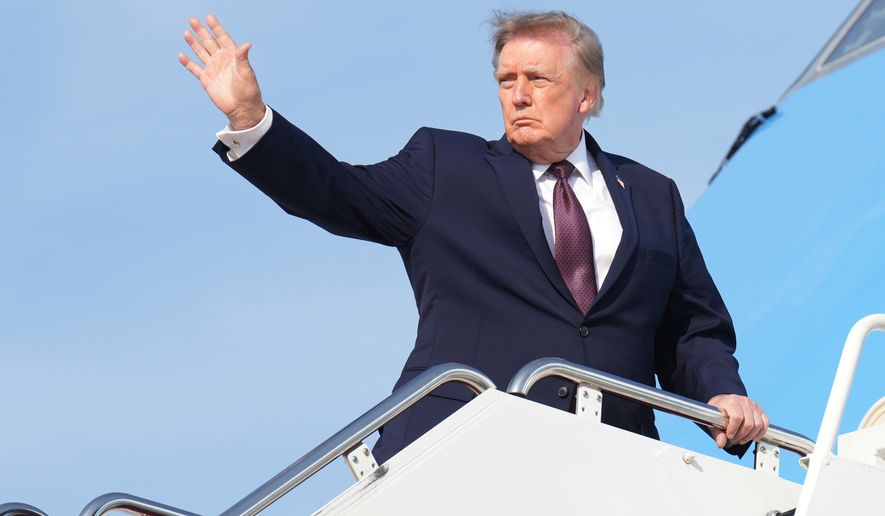

The Trump administration announced an immediate appeal Friday, a day after a federal judge issued a startling ruling finding that Congress lacks the power to bar noncitizens from casting ballots in federal elections.
Judge David Leibowitz’s decision applies, for now, only to the single criminal case before him, but his reasoning, if it stands, could undercut dozens of criminal cases that the Trump administration has brought against noncitizens in recent months for casting ballots.
Judge Leibowitz, a Biden appointee to the U.S. District Court for the Southern District of Florida, said the Constitution gives states the authority to determine voter qualifications, and states generally bar noncitizens from voting.
People were interested in these podcasts
He said that left no room for Congress, and therefore a law barring noncitizens from voting fell outside Capitol Hill’s purview.
“Congress has no power to say who can vote or who cannot vote in federal elections,” he wrote. “Some legal principles are so fundamental that they form American constitutional bedrock, and this case reveals a big one: When you’re prosecuted based on a law that Congress did not have the authority to pass, the prosecution cannot stand.”
He dismissed the federal misdemeanor case against Chelsea Cox, an illegal immigrant charged in October 2025 with voting in the 2020 election.
Hans von Spakovsky, senior legal fellow at Advancing American Freedom, said he expects Judge Leibowitz’s ruling “will be squashed” by the appeals court.
Mr. von Spakovsky said that although states set voter qualifications, Congress had authority over immigration matters and the issues that flow from them.
“That gives the federal government the authority to ban aliens from voting or otherwise in any way participating in the democratic process,” he said.
Mr. von Spakovsky pointed to a 2011 decision in Bluman v. Federal Election Commission, authored by then-Judge Brett M. Kavanaugh. Writing for a three-judge panel in the U.S. District Court for the District of Columbia, Justice Kavanaugh ruled that noncitizens with temporary status did not have the right to make contributions to political campaigns. Justice Kavanaugh said the Supreme Court has “long held that the government … may exclude foreign citizens from activities that are part of democratic self-government in the United States.”
That, Justice Kavanaugh said, included “that the government may bar aliens from voting.”
The federal law criminalizing noncitizen voting is relatively new, dating back to 1996.
Judge Leibowitz said no federal court had been asked to rule on its constitutionality until recently.
He said the Constitution does give Congress the power to regulate the times, places and manner of federal elections, but that cannot be stretched to allow barring an entire category of people.
Judge Leibowitz said states are free to bar noncitizens from casting ballots. Some are explicit in preventing it in all elections, while others bar it only for statewide offices and allow localities to make their own decisions.
That has spawned a recent rush of jurisdictions attempting to allow noncitizens to vote in local matters.
The District of Columbia explicitly allows noncitizens, including illegal immigrants, to vote on city issues, but not on federal offices.
Nearly a dozen municipalities in Maryland have adopted noncitizen voting for local matters.
Judge Leibowitz said Congress may have the power to prescribe immigration consequences, such as deportation, for noncitizens who vote. Indeed, such a law exists, and has recently been invoked by the Trump administration.
The judge said he was not deciding on that law’s constitutionality in the Cox case.
In the early days of the republic, noncitizen voting was common. Judge Leibowitz noted that all 13 original states allowed noncitizen voting in some fashion.
That began to change in the early 19th century. Arkansas was the last state to bar noncitizen voting in 1926.
President Trump has claimed that noncitizen voting is rampant and is skewing U.S. elections. Voting rights groups challenge that idea, saying evidence of the practice is scant.
The Justice Department, seeking to bolster Mr. Trump’s claim, has initiated more than 60 cases since January 2025.
Ms. Cox, a citizen of Jamaica, came to the U.S. in 1999 on a tourist visa but never left.
Authorities said she used a bogus birth certificate to obtain a Florida driver’s license and then registered to vote in the state in 2012.
She falsely claimed to have been born in the U.S. Virgin Islands, prosecutors said.
She voted in 2012, 2016, 2018 and 2020, though prosecutors charged her only for the last of those. The others fell outside the statute of limitations.
Ms. Cox had fought her case on several fronts, including accusing prosecutors of racism. She said she was being singled out because she was a Black immigrant.
Contact the author

Please read our comment policy before commenting.