



California’s proposed wealth tax is struggling to reach majority support, battered by an intense opposition campaign and by liberals divided over whether a one-time levy is worth the loss of rich job creators and future revenue to other states.
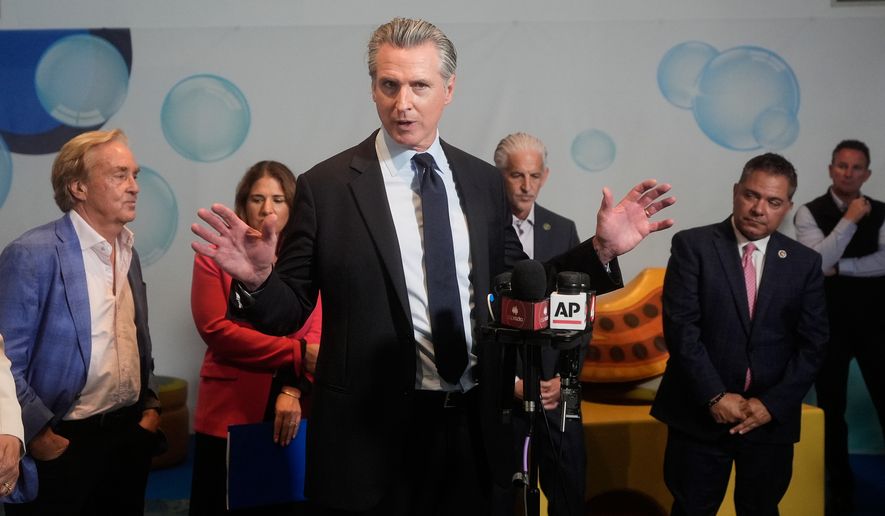
The one-time, 5% tax on people worth more than $1 billion seems like an easy win in liberal California, but Gov. Gavin Newsom, a Democrat, says a national wealth tax would be better so billionaires do not flee the state.
The Democratic nominee to succeed Mr. Newsom, Xavier Becerra, also opposes the ballot measure, known as Proposition 40.
People were interested in these podcasts
Although those Democrats still want wealthier Californians to pay their “fair share” of taxes, a broad coalition of opponents says the wealth tax will hurt the state economy.
Tech leaders, notably Google co-founder Sergey Brin, poured millions of dollars into opposition ads.
Complicating matters, competing measures known as Proposition 41 and Proposition 42 would effectively nullify the wealth tax if either receives more support than Prop 40.
Some voters might be inclined to vote down all three ballot questions.
“I think it causes people to feel like maybe they default to ’no’ on everything when they feel confused. That’s been borne out by past elections and studies on how voters react,” said Mary-Beth Moylan, a professor at the University of the Pacific McGeorge School of Law.
Fewer than half of likely voters, 46%, supported Prop 40 and 43% opposed it in a poll conducted Oct. 9-14 and sponsored by Politico and the UC Berkeley Institute of Governmental Studies.
The lack of majority support is a worrying sign for the Service Employees International Union-United Healthcare Workers West, or SEIU-UHW, proponents who say the tax on roughly 200 to 250 California billionaires is needed to backfill federal cuts to Medicaid coverage in Republicans’ One Big Beautiful Bill Act.
Ninety percent of the wealth tax revenue would go to healthcare, and 10% to food assistance and educational programs.
Some liberal groups oppose the tax because they fear it would cut investment in the state and would not be a sustainable revenue stream.
“They don’t see it as solving a longer-term problem with the cuts that are being made,” Ms. Moylan said. “It’s intended to only be, basically, a Band-Aid on that larger problem.”
Stanford University economists projected that the wealth tax would raise $30 billion — far short of the $100 billion estimated by proponents of Prop 40 — because some billionaires left the state early on.
The economists’ working paper said the tax would likely backfire.
As billionaires leave, the decline in future tax revenue would exceed the one-time windfall from the wealth tax.
“These findings suggest that the Billionaire Tax Act will not fulfill the primary functions for which it was designed,” authors Benjamin Jaros and Joshua Rauh wrote. “Although the act was designed to raise revenue, behavioral response prior to voting has eroded most of the projected tax base.”
The SEIU-UHW is driving support for the wealth tax. The union says the tax is necessary to restore fairness and fund healthcare programs.
The union said undecided voters will likely break in their favor and that polling shows Prop 40 is resilient despite an onslaught of negative ads.
“The coalition of groups who’ve endorsed Prop 40 are mobilizing audiences and making the case for Prop 40 through relationships built on trust. The billionaires can buy advertising. Billionaires can’t buy the kind of credibility that our coalition members have with their members and constituents,” SEIU-UHW Vice President Debru Carthan said.
Mr. Newsom, a Democrat eyeing a presidential run in 2028, opposes the one-time wealth tax and supports Proposition 42, a competing measure that would prohibit retroactive taxation and cancel Prop 40 if it passes by a greater margin.
However, Mr. Newsom proposed a nationwide wealth tax on those worth more than $100 million, hoping to avoid state-level taxes that rich people could dodge by moving around the country. Prop 40 sets a $1 billion threshold.
“It’s time for a national billionaire’s tax and a new social contract,” Mr. Newsom said in a social media video. “Just 10% of people in this country own two-thirds of the wealth.”
Rep. Ro Khanna, California Democrat, supports the tax and criticized Mr. Newsom, saying the governor did not want to cross the billionaires “bankrolling his campaigns.”
Sen. Bernard Sanders, Vermont independent, has pushed for a wealth tax.
“Never before have we seen such an unprecedented level of greed, arrogance and irresponsibility on the part of the ruling class of this country,” Mr. Sanders said at an Oct. 3 “Ballots Over Billionaires” rally in San Francisco.
An NBCUniversal Local/Telemundo Station Group poll conducted Sept. 21-24 and released on Sept. 30 showed 48% support for Prop 40 versus 38% against it, a handsome lead for the “yes” camp but short of majority support.
Conducted from Sept. 24 to Oct. 1 and published on Oct. 9, a poll by the conservative think tank Manhattan Institute swung the other way. Californians opposed Proposition 40, 50% to 35%.
A Nestpoint poll conducted by national pollster David Wolfson found that 54.6% of California voters oppose Proposition 40, while 34.1% support it. That was a sharp reversal from its August poll, which found 48.6% support versus 46.6% opposition.
“Voters get it. Capital flight isn’t a theory to Californians as they’ve watched it happen in real time for years, one moving truck to Texas at a time. A 22-point swing in six weeks, with ballots already in the mail, says this measure is headed for defeat,” said John Thomas, co-founder and managing director of Nestpoint, a government affairs, finance and private equity firm.
Some corporations are bracing for the tax before voters have their say.
Meta Platforms and Mark Zuckerberg have structured an arrangement to keep the CEO a California resident despite concerns about a wealth tax on the state’s Nov. 3 ballot.
Mr. Zuckerberg will be eligible for a new class of stock shares that he could sell to satisfy a potentially massive tax bill if voters approve Prop 40.
Mr. Zuckerberg agreed to remain a resident of California, or wherever Meta maintains its headquarters, for eight years.
Meta said it was important for Mr. Zuckerberg to work closely with California operations, including its Meta Superintelligence Labs.
Contact the author

Please read our comment policy before commenting.