


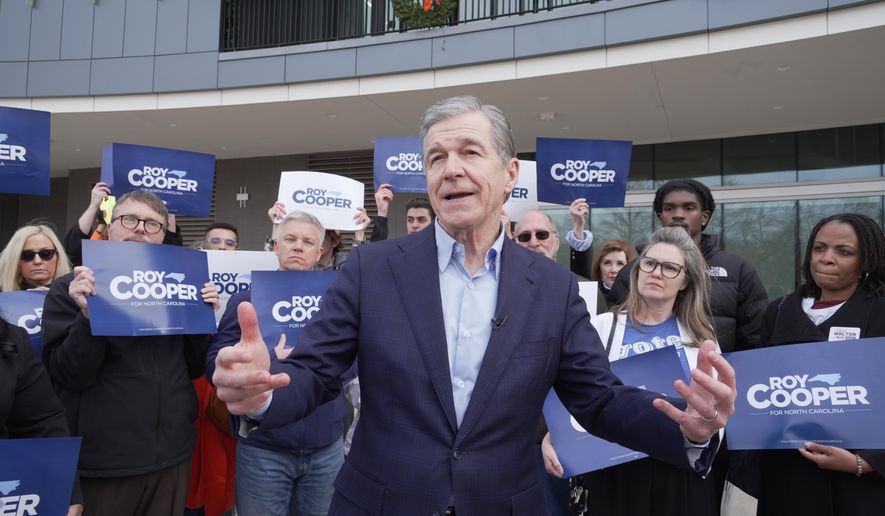

Democrats’ path to the four seats they need to flip the U.S. Senate likely starts in North Carolina, where former Gov. Roy Cooper is trying to win over voters with his “Make Stuff Cost Less” slogan.
From there, Democrats see their other best opportunities to pick up seats in Maine, Ohio, Alaska, Texas and Iowa, and some are even wondering whether Kansas could be nudged into play.
None is a sure thing.
People were interested in these podcasts
Republicans say Democrats are in for a reality check because summer polling has been flat-out wrong before and races are tightening in places such as North Carolina.
Political handicappers warn that Democrats can abandon their majority ambitions if Mr. Cooper loses the race against Republican Michael Whatley to replace retiring Sen. Thom Tillis, a Republican.
As Jacob Rubashkin of Inside Elections put it, “It is hard to see a Democratic Senate majority that doesn’t include North Carolina.”
Democrats have a steep climb: Republicans hold a 53-47 majority. Of the 35 seats on the November ballot, Democrats must defend all of their own and flip four Republican‑held seats — including in states such as Ohio, Iowa and Texas, which Mr. Trump carried in each of the past three presidential elections — to take control of the Senate.
“After North Carolina, Democrats have a lot of promising opportunities, but they haven’t really locked anything down yet,” said J. Miles Coleman of the University of Virginia’s Center for Politics.
That task is complicated by lingering concerns about Democratic-held seats in Michigan — where Democrat Abdul El‑Sayed is facing Republican Mike Rogers — and in New Hampshire, where Democratic Rep. Chris Pappas is up against Republican John Sununu, a former U.S. senator.
Another wild card is Sen. John Fetterman, Pennsylvania Democrat.
After the midterm elections, Democrats might actually need five seats, given Mr. Fetterman’s repeated breaks with his party and speculation that he could switch political parties despite his vows not to.
“I wouldn’t count on him finishing his term as a Democrat,” Mr. Coleman said.
Mr. Trump’s political operation and national Republicans in late August made significant new fundraising moves, raising worries among Democrats that they could be financially outgunned.
Still, several Democratic candidates running for open seats have built clear fundraising advantages, giving them access to discounted television ad rates that are not accessible to super PACs or other outside groups.
Buoying Democrats, a New York Times poll released Tuesday showed them with a 9‑percentage-point lead on the generic ballot, Mr. Trump’s approval rating at 38% and majorities of voters disapproving of his handling of the economy, the Iran war and immigration.
Those numbers reinforced the notion that a blue wave is taking shape — strong enough not only to help Democrats in competitive races but also to potentially widen the map.
Sen. Kirsten Gillibrand of New York, chair of the Democratic Senatorial Campaign Committee, said Tuesday that the midterms offer voters a chance to rebuke Mr. Trump for adding to the rising costs of food, housing and healthcare.
“Voters are furious that this president has lied to them and not done what he said. He said no forever wars, yet we’re mired in the war in Iran,” she said on CNN. “He said he would get costs down. He’s got billions of dollars for his billionaire buddies, for his bombs, and for his ballrooms, but he has nothing for the American people that are trying to make ends meet and put food on their table.”
That is the thrust of the Democrats’ message, including in Maine, where they are once again targeting Sen. Susan M. Collins, the battle‑tested Republican chair of the Senate Appropriations Committee.
The race was upended over the summer after Democrat Graham Platner’s insurgent bid collapsed amid rape allegations, prompting the party to replace him with former state Senate President Troy Jackson. Mr. Jackson has struggled to re-create Mr. Platner’s campaign magic and has faced scrutiny over his previous conservative stances of opposing abortion and same-sex marriage. He has also been scrutinized for fathering children with his second cousin.
Ms. Collins, meanwhile, remains one of Maine’s most recognizable political figures, bolstered by decades of relationships across the state and a proven track record of securing federal funding, especially in the economically distressed parts of the state.
Democrats are working to chip away at the independent image she honed over 30 years in the Senate, arguing that despite her reputation for bucking her party, Mr. Trump has been able to count on her vote.
In a blue‑wave environment, they say, that could become a liability. Recent polls show Mr. Jackson leading.
Beyond Maine, Democrats see their next best chances in Ohio and Alaska.
In Ohio, former Sen. Sherrod Brown, an Ohio Democrat, is locked in a competitive race with Republican Sen. Jon Husted, who was appointed to the seat previously held by Vice President J.D. Vance.
Mr. Brown, who lost his seat in 2024 to Sen. Bernie Moreno, has made Mr. Husted’s past support for data centers a central part of his message, saying that data centers have forced voters to pay higher utility bills.
Still, the race is unfolding in a state Mr. Trump carried by 11 points over Kamala Harris — a reminder of the headwinds Democrats face.
The Democrat running in Alaska, former Rep. Mary Peltola, is giving Republican Sen. Dan Sullivan a serious challenge. She has won statewide before and built a winning coalition, giving Democrats hope in a state where cross‑party appeal matters.
Both races have revolved around voters’ top concerns: the economy and affordability, including high gas prices from the war with Iran.
Ms. Peltola has raised nearly $7 million more than Mr. Sullivan and more than doubled his spending through the end of July.
Both parties are also keeping close tabs on Texas and Iowa. In Texas, Democratic state Rep. James Talarico, a former teacher, and Attorney General Ken Paxton are vying to replace Sen. John Cornyn, who lost the Republican primary to Mr. Paxton.
The race has also drawn the attention — and money — of the Trump political machine. MAGA Inc., the super PAC aligned with the president, recently launched a multimillion‑dollar television and digital ad blitz in the state, including a wave of negative ads aimed at Mr. Talarico and a parallel effort boosting Mr. Paxton.
The investment marks one of the group’s largest general election spends so far and underscores how Republicans view the seat as central to their hold on the Senate.
In Iowa, Democratic state Rep. Josh Turek, a decorated wheelchair basketball player, is facing Republican Ashley Hinson for the seat of retiring Sen. Joni Ernst, a Republican.
Ms. Hinson is seen as a slight favorite in the race.
Bernadette Breslin, spokesperson for the National Republican Senatorial Committee, the campaign arm for Senate Republicans, said Democrats are in trouble.
“Chuck Schumer’s socialist Senate slate may have won its primaries, but general election voters will reject Abdul El-Sayed, Troy Jackson, Josh Turek and the crippling tax hikes they’re campaigning on this November,” she said.

Please read our comment policy before commenting.