


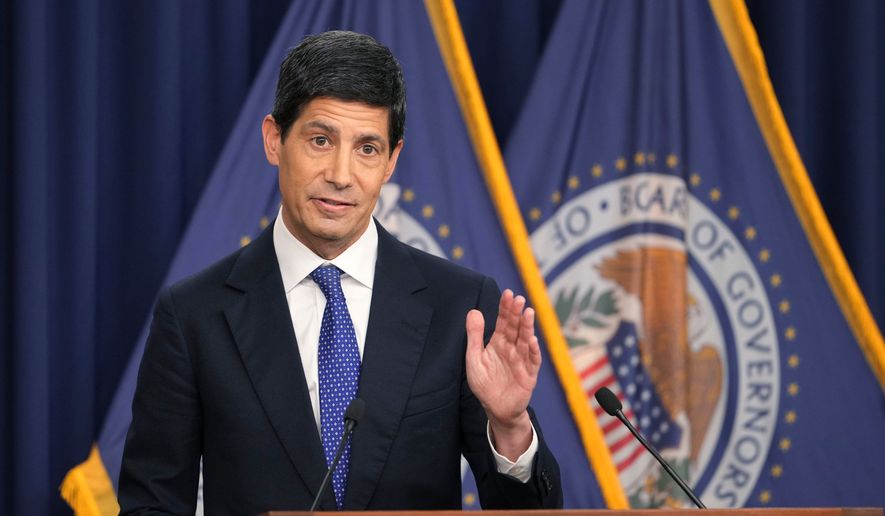

The Federal Reserve raised interest rates Wednesday for the first time in three years, attempting to control inflation with a move that defied President Trump’s wishes and clashed with his upbeat economic message to midterm voters.
The Federal Open Market Committee voted unanimously for a 0.25-percentage-point increase in its benchmark rate, bringing the target range to 3.75% to 4%.
The move angered Mr. Trump, who has repeatedly pressured the central bank to lower rates and recently threatened to cut off trade with countries that sell heavily to the U.S. market but buy far less from American producers.
People were interested in these podcasts
“Interest Rates in the United States should be 1%, or less, because we are the Best Credit in the World — BY FAR. Our Country is BOOMING with new Investment!” Mr. Trump wrote on Truth Social.
Yet Mr. Trump’s handpicked chairman, Kevin Warsh, and other central bankers said they had no choice but to raise rates after a series of inflation readings came in hotter than they would have liked.
Mr. Warsh said the economy appears to be strengthening overall, but inflation “remains elevated,” and that geopolitical developments — an allusion to the Iran war — have forced the Fed to focus on the price side of its mandate.
“Today’s policy action will support a timelier return to the committee’s 2% goal. This committee will deliver price stability,” he said.
“The least well-off,” he said, “are the ones that have the most to gain from stable prices.”
The stock market, which had been in positive territory for most of the day, nosedived after the Fed’s announcement and its indication that another rate hike is likely later this year. The Dow Jones Industrial Average closed down 699 points, or 1.6%, while the S&P 500 fell 1.5% and the Nasdaq Composite dropped 1.7%.
The Fed raises rates when inflation is high to slow the economy and reduce demand for goods and services, thereby helping stabilize prices.
The central bank’s benchmark rate has a trickle-down effect on interest rates for personal and business loans and investments.
Mr. Trump appointed Mr. Warsh to replace Jerome Powell with an eye toward lower rates, which makes this Fed decision all the more momentous.
Mr. Warsh is caught between Mr. Trump’s wishes and an annual inflation rate that remains well above the Fed’s 2% target.
The consumer price index, a leading measure of what American consumers pay for common goods and services, rose 3.4% for the year ending in August, the government reported on Friday.
Mr. Trump says the economy’s fundamentals and job picture remain strong, and Americans deserve more favorable borrowing terms through lower interest rates.
He says slashing rates will unleash economic growth.
“When our business is good, we should lower interest rates. You want to build America? You are going to see building like you’ve never seen [when rates drop],” Mr. Trump told reporters in August.
Mr. Warsh pledged to deliver price stability; however, the Fed decided it could no longer stand pat. Because the vote was unanimous, it undercut Mr. Trump’s claim that Mr. Warsh was hamstrung by holdover Democratic appointees on the rate-setting committee.
On Wednesday, Mr. Trump did not scold Mr. Warsh directly, but he revived an unusual idea: cutting off trade with countries that sell plenty of products to the rich U.S. market but buy far less from American producers.
“If we stopped Trading with every country that we have a Deficit with, which is most of them, we would make, at least, 1.5 Trillion Dollars a year,” he said. “The word ’Deficit’ is nothing more than a fancy word for LOSS. We are ’carrying’ almost every country in the World, and that cannot go on any longer.”
The U.S. runs trade deficits with leading partners, including Canada, Mexico and the European Union, so cutting off trade would be an extreme step.
Beyond economic strategy, the Fed’s move is a political blow to Mr. Trump because it suggests a segment of the economy needs a course correction nearly halfway through his term.
For months, Mr. Trump has touted a “Golden Age” of America through foreign investments in American jobs and a trade agenda that tilts the playing field back toward U.S. workers.
He says Republicans delivered tax relief with the One Big Beautiful Bill Act, putting money back into people’s pockets despite Democrats’ critiques about inflation and the high cost of living.
“More Americans are working in the United States right now than at any moment in the history of our country,” Mr. Trump told a Las Vegas crowd on Aug. 5. “The economy is the greatest economy by far.”
Mr. Trump campaigned in 2024 on a promise to lower prices after a period of rampant inflation under President Biden.
Inflation came down from a 40-year high of more than 9% to about 3% by January 2025. It has ranged from 2.3% to 4.2% in Mr. Trump’s second term.
After cutting rates three times last year, the Fed is now reversing its steps.
During his press conference, Mr. Warsh stressed the economy’s upsides, including relatively low unemployment, and said inflation has been a problem for at least five years.
“The plain fact is that inflation is too high and has been for too long,” Mr. Warsh said.
Energy prices from the Iran war are a key driver of inflation. Oil prices have risen above $100 per barrel, and diesel fuel hit a record national average high of $6.31 per gallon on Wednesday, according to GasBuddy data, an expense that will raise transportation and freight costs and filter through the economy.
“Some American stores have started to ration motor oil — that’s how desperate the situation has become. And when the price of gas goes up, so does the price of everything else,” Senate Minority Leader Charles E. Schumer, New York Democrat, said during a Wednesday press briefing at the Capitol.
Rates are often changed in bunches, and Fed members signaled another rate hike is likely this year.
It might decline to take that step at its upcoming October meeting, right before the November elections, meaning a December increase is possible.
Some economists say responsibility for stable prices extends beyond the central bank.
Ryan Young, a senior economist at the Competitive Enterprise Institute, said ending the Iran war would eventually bring down energy prices, while ending the trade war with Canada would ease cost pressures from tariffs on key industrial sectors.
“The answer is not necessarily in the Fed’s hands,” he said. “Upcoming policy choices on Iran, Canada and tariffs will play a large role.”
Contact the author


Please read our comment policy before commenting.