


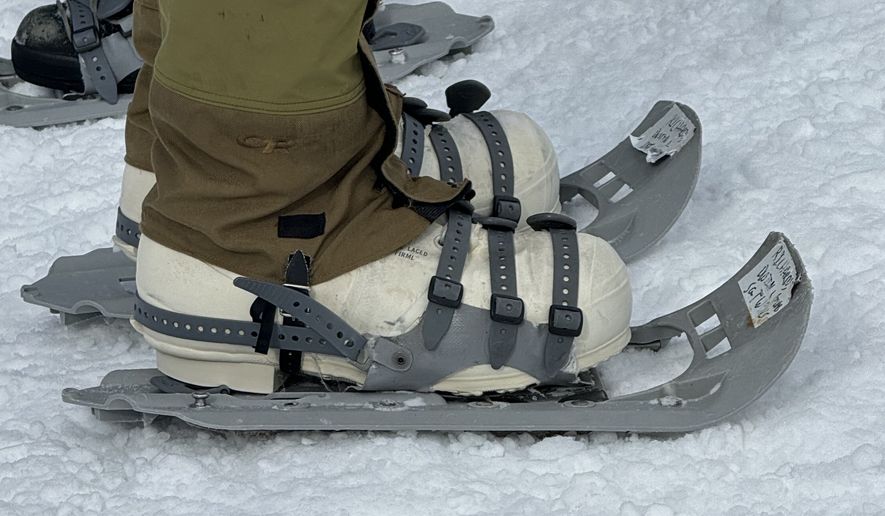

Cold-weather boots issued to U.S. Marines fell apart in the field during a NATO exercise in Norway this year, forcing troops to buy replacements on the local economy and reopening a fight in Congress over rules requiring American-made military footwear, according to a Newsweek investigation published Wednesday.
The failures surfaced during pre-exercise training for Cold Response 2026, the Norwegian-led drill that brought together more than 25,000 troops in Norway and 7,000 more in Finland. Roughly 3,000 Marines with the II Marine Expeditionary Force out of Camp Lejeune, North Carolina, took part. Within days of hitting the snow in February, Marines found the leather on their boots splitting and the soles separating, letting freezing water seep in, according to Newsweek’s reporting, which cited a Pentagon official and internal military records.
Some Marines bought replacement boots from Norwegian retailers. Others were issued Norwegian-army M77 boots made by Alfa, a company that developed the model with Norway’s military in the 1970s. An unnamed Pentagon official told Newsweek that “enormous sets of issues” arose with the U.S.-made footwear. A Marine Corps spokesman, Lt. Col. Kurt Stahl, disputed part of the official’s account, saying no Marine Corps resupply ship was rerouted to deliver replacement boots.
The Marine Corps confirmed the boots at issue were Intense Cold Weather Boots made by Belleville Boot Co., an Illinois-based manufacturer that describes its products as built to the standards demanded by “warfighters around the globe.” Follow-up inspections at Camp Lejeune found the problem worsening: An April review of 2,642 pairs turned up a 6.93 percent defect rate, and a July review of 1,781 pairs found defects in nearly 20 percent, according to Newsweek’s account of an internal Marine Corps briefing. The industry standard, the briefing said, is 2 to 3 percent.
The Defense Logistics Agency, which supplies the Belleville boots to the Marine Corps under a commercial contract, told Newsweek it is “aware of the issues” and has been assisting with inspections. Belleville said it is “committed to continuous quality improvements” and is working directly with the Marine Corps to resolve the defects.
The episode lands squarely in the middle of a congressional fight over the Better Outfitting Our Troops Act, legislation that would tighten the decades-old Berry Amendment’s domestic-sourcing rules and bar Marines from wearing optional combat boots unless they are made entirely in the United States. The provision was stripped from the House’s fiscal 2027 defense authorization bill but was reintroduced in the Senate in July.
SEE ALSO: ‘Everything takes longer’: Arctic Army exercise grinds on as temperatures plunge to -40
Critics argue the push could backfire. A Pentagon official told Newsweek that American manufacturers are not keeping up with demand or quality even now. Chris Perrotti, who oversees manufacturing at boot maker Danner, said U.S. producers “can’t support a military ramp up” if the market for foreign-made alternatives — such as the Cambodia-made boots from U.S.-registered company OTB, which the Marine Corps approved for wear in June — is closed off.
The concern is backed by a 2024 study commissioned by the Defense Logistics Agency from the CNA think tank. In one hypothetical wargame scenario the report modeled, the domestic clothing-and-textile industrial base — currently topping out at about 525,000 boots a year — would need to produce nearly 1 million annually to meet full mobilization demand, a gap the report said would require significant investment even before a conflict began.
A Senate provision addressing boot industrial-base reporting and Berry Amendment compliance, offered by Sens. Susan Collins and Tammy Duckworth, was filed to the defense authorization bill and ordered to lie on the table, according to the Congressional Record — leaving its fate, along with the broader BOOTS Act, unresolved as lawmakers continue work on the legislation.
Backers of the BOOTS Act hope to eventually extend its reach beyond the Pentagon to the Department of Homeland Security, whose Immigration and Customs Enforcement component has grown by more than 120 percent in a year, according to the Pentagon official cited by Newsweek.
This article was constructed with the assistance of artificial intelligence and published by a member of The Washington Times' AI News Desk team. The contents of this report are based solely on The Washington Times' original reporting, wire services, and/or other sources cited within the report. For more information, please read our AI policy or contact Steve Fink, Director of Artificial Intelligence, at sfink@washingtontimes.com
The Washington Times AI Ethics Newsroom Committee can be reached at aispotlight@washingtontimes.com.

Please read our comment policy before commenting.