


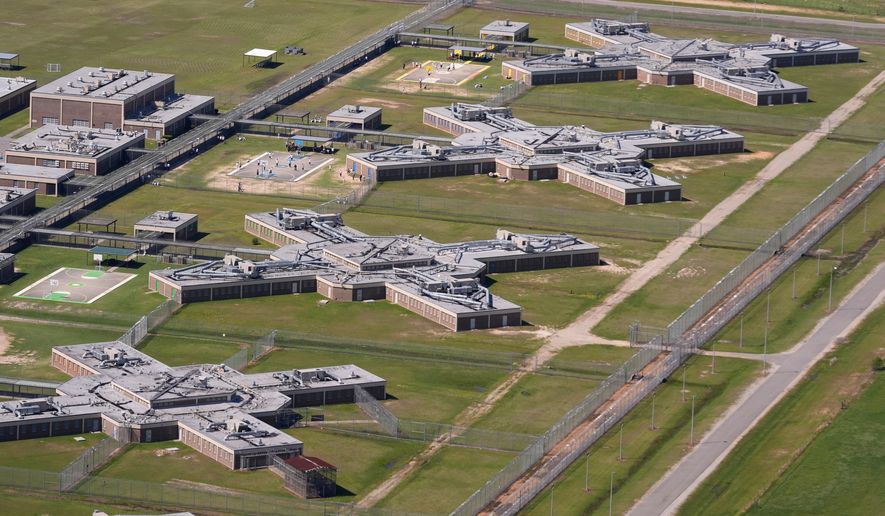

ICE’s effort to rapidly build its detention capacity has wasted millions of dollars as the Trump administration took a spend-first, ask-questions-later approach, the Government Accountability Office said in a withering audit Thursday.
The attempt to buy and convert warehouses to migrant detention centers has collapsed, with U.S. Immigration and Customs Enforcement now seeking to sell seven of the 11 properties it rushed to buy.
Yet even if the agency can sell, it has already sunk $20 million that cannot be recovered, such as in zoning work, utilities and security, according to the GAO, Congress’ investigative force.
People were interested in these podcasts
The idea to set up tent detention camps at U.S. military bases also faltered, but not before ICE wasted millions of dollars, including paying to feed 5,000 detainees at Camp East Montana despite housing far fewer there.
ICE and the Defense Department also paid more than $100 million to house migrants on the base at Guantanamo Bay, Cuba, even though the average daily population this year has been just 16 detainees.
All told, of the six ideas ICE had to rapidly expand its detention space, it has retreated from four, the GAO said.
“In the absence of a comprehensive strategic plan to guide detention expansion, ICE has wasted funds on unsuccessful detention initiatives and lacks important information about the long-term affordability of its investments,” Heather MacLeod, director of the GAO’s homeland security and justice division, said in the report.
ICE has $45 billion earmarked for detention under President Trump’s One Big Beautiful Bill Act, signed last year, plus billions of dollars from the 2026 reconciliation law, the Secure America Act.
The agency had set a goal of increasing the number of migrants in detention from fewer than 40,000 at the end of the Biden administration to about 100,000 under Mr. Trump.
Detaining migrants is a crucial part of being able to deport them. If they are released, their cases drag on for years on the “nondetained docket,” and it is much harder to compel their departure if they lose.
If they are on the “detained docket,” their cases can be completed within weeks and they can be removed as soon as their travel documents are secured and a flight is available.
On Inauguration Day in 2025, Mr. Trump issued an executive order directing the Department of Homeland Security to allocate all available resources for ICE detention, a directive Congress backed with billions of dollars in funding.
The four ideas ICE came up with but has already scaled back were using Guantanamo, using domestic bases, buying the warehouses and having states erect temporary facilities such as Florida’s now-shuttered Alligator Alcatraz.
In Florida, ICE paid $249 per migrant per day, more than 2½ times the $92 ICE spent on the average bed in 2026.
Two other ideas are still moving forward.
One is renting space from the federal Bureau of Prisons, where ICE is paying $182 per migrant per day, or nearly double the $92 average.
The other is buying out existing facilities where ICE had rented space.
In July, ICE bought two facilities for $1.5 billion. The GAO said those purchases could result in waste because ICE has not calculated the long-term ownership costs.
The larger problem, the GAO said, was that ICE lacked a strategic plan for expanding detention.
ICE’s audit liaison, David E. Schmitt, in an official response to the GAO audit, agreed that the agency needed a strategic plan. He said it should be done by Aug. 31, 2027.
“Securing the nation’s borders and safeguarding the integrity of the immigration system is ICE’s primary focus and ICE plans to continue to meet the growing demand for bed space by streamlining the detention and removal process and focusing on non-traditional facilities built specifically to support ICE’s needs,” he said.
Sen. Richard J. Durbin, an Illinois Democrat who helped request the GAO audit, said it exposed a “cavalier and wasteful” approach to taxpayers’ money by ICE.
“Remember when Donald Trump promised to get rid of ‘waste, fraud, and abuse’ in Washington? Well, the GAO has now exposed a shocking pattern of waste within the administration’s unconscionable mass deportation campaign,” Mr. Durbin said.
Contact the author


Please read our comment policy before commenting.