



RIO DE JANEIRO — Crime is the top concern for Brazilians ahead of October’s presidential election, with candidates competing to offer the toughest — and most effective — approach to the deep-seated problem.
Sen. Flávio Bolsonaro, son of ex-President Jair Bolsonaro, is seeking to defeat President Luiz Inácio Lula da Silva, with a promise to loosen organized crime’s grip on Brazil, particularly in Rio de Janeiro.
After Rio’s deadliest-ever police operation last year, in which more than 120 people were killed, polls indicated that the hard-line policies Sen. Bolsonaro touts are popular. Lula, meanwhile, has argued for a more prominent role of the federal government in the fight against organized crime as well as greater coordination between governmental institutions.
People were interested in these podcasts
But while politicians trade barbs, residents in Rio de Janeiro have been designing their own responses, with ex-traffickers launching podcasts and grieving mothers stepping up to stop youth recruitment.
Many residents, community leaders and experts say that the current approach — which favors armed confrontations between police and the groups — is inefficient and often results in indiscriminate loss of life. They’re taking on crime on their own to bridge that gap.
Here is a look at some local initiatives.
PHOTOS: Rio residents find their own way to tackle gangs as crime dominates Brazil’s election
Podcast warns of the dangers of gang life
Once a week, a group of former drug-traffickers gather in a small recording studio on the outskirts of Rio to dissect their past lives of crime and those of their guests. They air the episodes of 01 Sobreviventes, or 01 Survivors, on YouTube and streaming platforms.
A painting of the four founders grinning hangs on the wall, while the podcast’s logo — a microphone breaking a chain — is projected on a screen over the desk.
“We want to propagate the idea that crime isn’t worth it,” said host Fábio Santos, a 56-year-old ex-trafficker from the Manguinhos favela who spent 25 years in prison.
“We want them to follow our current lives so that they don’t go through what we went through,” he added after recording a recent interview with a former gang member who is now a pastor.
The podcast, launched in 2024 and followed by more than 225,000 people on Instagram, is both for those tempted by the allure of quick cash and for those who need convincing to course-correct. Crime leads to prison, a wheelchair or a coffin, they say repeatedly.
Santos says several people have said they have seen traffickers listening to the podcast and that he regularly hears about people who left the world of crime or didn’t enter thanks to their work.
Martial arts keep youth from a perilous path
Alan Duarte, 38, grew up in Complexo do Alemao, one of the two sprawling complexes of favelas targeted in Rio’s lethal police operation last year. He lost a brother, uncle and cousins — 10 family members in all — to violence.
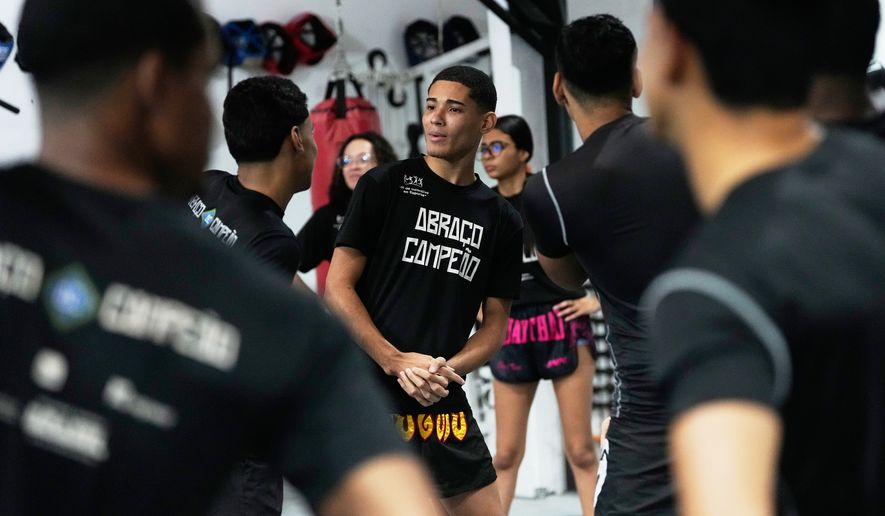
He credits the influence of a nonprofit offering martial arts classes in a nearby favela for keeping him from going down a perilous path. That insight inspired Duarte to create his own academy in his childhood neighborhood.
Since opening in 2014, Abraco Campeao, or Embrace Champions, has expanded into teaching boxing, jiu-jitsu, Muay Thai and capoeira, and providing educational talks. Duarte hopes to boost its current 600-student capacity to 1,000.
“I often say that martial arts, Abraco Campeao, offers the same things that draw youngsters to gangs: identity, respect, attention, authority and a sense of belonging,” Duarte said during a recent tour of the school.
Classes, uniforms and equipment are free. During one of the thrice-weekly classes, attendees have an hour-long discussion with an educator about themes ranging from environmental issues to relationships.
Mherrhy Esperança Rosário, a 23-year-old amateur boxer who has been part of the school for more than a decade, is studying software engineering at a nearby university. He said the school changed his life.
“Abraco Campeao offers a path that is different to what we often see around here,” he said. “It shows that we can attain our dreams.”
Job opportunities offer a way out
When two armed men turned up to Vanderson Rocha Silva’s electricity course in a Rio favela asking if they could join, the 43-year-old didn’t turn them away. Today they are both working as electricians.
“If they want to leave crime but they don’t have an employment opportunity, any hopes for life, what are they supposed to do? A project changes everything,” Rocha Silva said.
Rocha Silva grew up in an abusive household in the famed City of God favela and was 8 when he entered the world of drug-trafficking.
After stints in prison and converting to Evangelical Christianity, he eventually left that life behind and now runs what he calls a therapeutic community, named “R3,” which stands for Rescuing, Resocializing and Resending. The organization offers psychological assistance as well as free electricity, refrigeration and English courses.
“I’m starting my life again,” said Danilo Gomes da Silva, 37, who was once addicted to cocaine and involved in a criminal organization. He now has a job in building maintenance and is slowly furnishing a small home; a fridge is on its way.
“Look at all (the pastor) is doing without help from the state. Imagine all the people he could resocialize,” he said.
A grieving mother helps young boys
Nadia dos Santos’ son Cleyverson ran a social project that distributed food, medicine, clothes and other essentials to people in need in the Chapadao complex of favelas where he grew up. After police killed him in 2022 when he was 17, his mother shifted the focus of the project specifically to help youth under 26 get jobs and training.
“We have to get them out of the world of criminality where they are used to living,” dos Santos said.
Due to funding challenges, the project is still in its early stages, hosting occasional events. Dos Santos plans on transforming a house she owns into its headquarters, with a room for computers and another for a community food center.
At a recent event she organized in her son’s memory, other grieving mothers called for a change in the approach to security in Rio.
Maria Rubia Brito da Silva, a 61-year-old who was at the event, said her son and grandson became involved in drug trafficking and were later killed.
“Even if our sons become involved in the wrong kind of life, the state doesn’t have a right to take their lives away,” she said.
Brito da Silva blamed the lack of educational, recreational and employment options for youth’s gang involvement. She says her granddaughter hardly has class because of police operations.
“If there were opportunities for these children, I’m sure they would leave the streets and their self-esteem would soar,” she said.
“They would be able to lead a dignified life and bring lots of pride to us mothers who live with the fear of losing our sons.”

Please read our comment policy before commenting.