


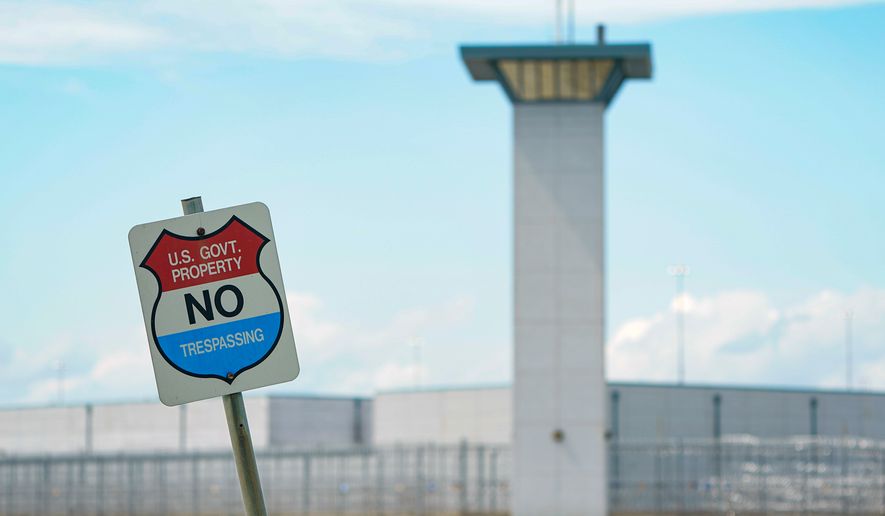

The federal government spends $1 billion a year to keep foreign citizens in its prisons, according to a study released Monday that put a price tag on at least part of immigration’s costs and delivered a probing look at who the criminals were.
Mexicans predominated among the noncitizens, with immigrants from northern Central America, Colombia and the Dominican Republic rounding out the top of the list.
Noncitizens accounted for about 15% of murderers behind bars — about the same percentage as their share of the overall federal prison population.
People were interested in these podcasts
Yet foreigners were overrepresented among those behind bars for drug offenses, fraud and money laundering, according to the Government Accountability Office.
They were underrepresented in robberies, burglaries, arsons and firearms convictions.
Of those held by the feds from 2017 to 2024, about 10% ended up behind bars more than once, including 400 who were reincarcerated at least three times after their initial release, the GAO said.
That rate is likely lower than that of the general population, partly because the majority of noncitizens are deported after their release from federal prison.
All told, the federal government spent $8 billion to incarcerate noncitizens in the Federal Bureau of Prisons from 2016 to 2023. The cost exceeded $1 billion at the start of that period, dipped in the middle and then rose, even as the total number of people dropped.
The GAO said one likely explanation was the Biden administration’s curtailment of the use of private prisons, which had been employed in particular for low-security inmates.
“We noted that this time period coincided with the end of [Bureau of Prisons] contracts with privately operated criminal detention facilities, which were its lowest-cost facility type,” the GAO said.
According to the report, the government paid as much as 35% less for a bed in a private prison.
Rosemary Jenks, policy director at the Immigration Accountability Project, said that was a consequence of the large number of immigrants — now at record levels — in the U.S.
“If we have mass immigration, we’re also going to have mass incarceration. So it’s one of the costs of mass immigration,” Ms. Jenks said.
Experts have long debated the overall level of illegal behavior among the immigrant population as a whole and the illegal immigrant population in particular.
The GAO data does not speak directly to that.
The GAO did say that the Department of Homeland Security reviewed about 62,700 foreign criminals when they were taken into Bureau of Prisons custody and found that about two-thirds already had deportation orders or were in deportation proceedings.
The report highlighted 35 noncitizens who were incarcerated between 2017 and 2024 and later naturalized as U.S. citizens.
Of those, 11 had fraud and bribery convictions and eight had drug-related offenses. Two had weapons offenses, and one had an aggravated assault conviction yet was still granted citizenship.
In addition to the Bureau of Prisons costs, the Justice Department spends roughly $200 million more per year in reimbursements to state and local governments to cover some of the costs for holding illegal immigrants in their prisons and jails.
The State Criminal Alien Assistance Program, which reimburses correctional officer salary costs, is supposed to compensate state and local governments for some of the costs of holding people who presumably would not be in the U.S. if the federal government had prevented illegal immigration.
Reimbursement covers a quarter to a third of the cost of holding an illegal immigrant.
One difference between the Bureau of Prisons and the states is that three-quarters of those who passed through federal prisons had immigration crimes on their records. There are generally no similar immigration crimes at the state level.
Contact the author


Please read our comment policy before commenting.