



Details of President Trump’s planned Golden Dome missile defense remain hidden to prevent China and Russia from building countermeasures, but that secrecy is setting off a debate among lawmakers and missile defense experts about both costs and whether the system will work.
Analysts at a Senate hearing on Tuesday agreed that threats from long-range intercontinental ballistic missiles, cruise and hypersonic missiles and drones are increasing, along with the need for both traditional and new high-technology defenses against them.
Plans for the system remain highly secret to prevent adversaries such as China and Russia from developing countermeasures, Sen. Deb Fischer, chairman of the Senate Armed Services Committee strategic forces subcommittee, said at the hearing.
People were interested in these podcasts
“We do not want our adversaries to know the exact contours of Golden Dome. Unfortunately, keeping these details from the public has led to irresponsible speculation, often based on false assumptions about what Golden Dome will look like and what it will cost the taxpayer,” she said, referring to a May estimate by the Congressional Budget Office.
David E. Mosher, director of National Security Analysis at the Congressional Budget Office, said at the hearing that based on President Trump’s executive order, the office estimates the cost of a comprehensive space and ground defense could be $1.2 trillion over 20 years.
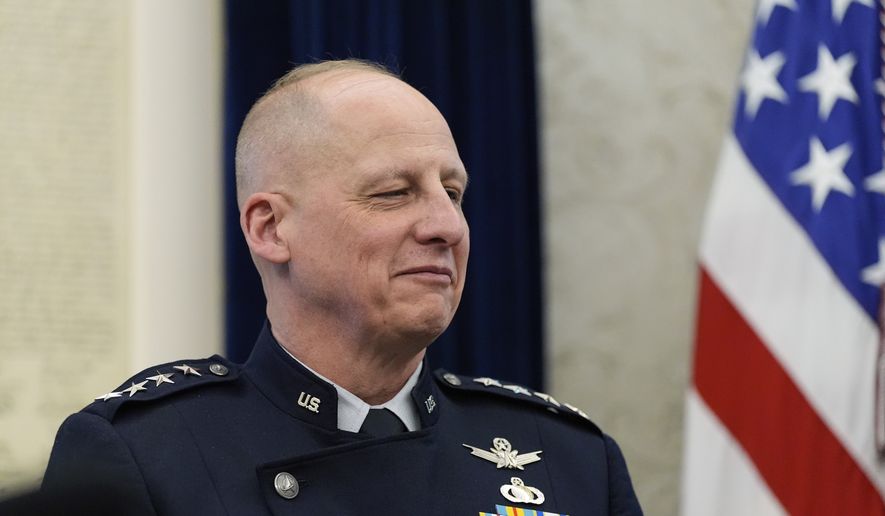
That figure is sharply higher than the cost estimate made public by Space Force Gen. Michael A. Guetlein, Trump administration’s point man on Golden Dome, who put the figure at $185 billion through 2035.
Sen. Angus King, Maine independent, said he believed agents from China and Russia were watching the hearing to learn Golden Dome secrets.
“But on the other hand, this will be one of the most expensive and largest projects ever undertaken by the United States government, and therefore, the American people have a right to know how much of their money is going to go for this purpose and what will be achieved, how this can and should be effective,” Mr. King said.
David Trachtenberg, former undersecretary of defense for policy in the first Trump administration, said Golden Dome is urgently needed to deter and counter advancing missile threats that limit civilian and military leaders’ options.
“I believe the risk of coercive threats from adversaries with a variety of increasingly capable missile systems is growing,” he said. “An effective Golden Dome system can help mitigate these concerns.”
Mr. Mosher defended the May CBO cost estimate, which he said was based on a notional system of four layers of missile interception: A space-based component, two wide-area ground layers, and separate, smaller regional sector layers for focused regional protection of key cities and strategic military facilities or national infrastructure.
Mr. Mosher, however, told the committee that the CBO estimate is speculative and that costs could be higher, or lower depending on what weapons are deployed and how soon.
“The biggest determinant of whether the costs are higher or lower is the size of the threat and the type of the threat that the defense is designed to handle,” he said, noting the founding executive order placed a high bar on building a nationwide defense.
Golden Dome program officials provided the first briefing to the CBO on Friday and all details remain classified.
“I can’t talk about that here, but it is true that if you’ve built it in a phased way or built less, it would cost less,” Mr. Mosher said.
Thomas O. Karako, a missile defense expert, said the Golden Dome program has been misconstrued by both critics and supporters and suffers from lack of strategic messaging from the administration.
Strategic attack is no longer limited to a major nuclear strike but today includes, cyberattacks, long-range missiles and drones, such as Ukraine’s bold drone strikes on strategic bombers deep inside Russia, he said.
Golden Dome is about creating a limited measure of air and missile defense to bolster stability and deterrence.
“Weakness here is provocative. The absence of air and missile defense invites crisis, instability, tempting an adversary to try a disarming nonnuclear first strike. It’s not deterrence. It is an invitation to an adversary to see what they can get away with short of a nuclear reprisal,” said Mr. Karako, director of the missile defense project at the Center for Strategic and International Studies.
Golden Dome defense is a “home game” and thus costs can be limited and not as large as the $1.2 trillion estimate, he said.
The most immediate need, Mr. Karako said, is for Congress to appropriate funds for both the munition acceleration ramp and this homeland defense effort.
Mr. Trachtenberg said the need for a nationwide defense is highlighted by the threats from China and Russia.
Both are engaged in “very aggressive” nuclear strategic and nonstrategic modernization programs with new and more sophisticated weapons.
China’s nuclear modernization is highlighted by the deployment of 320 ICBM silos in western China that suggests Beijing has abandoned a minimum deterrence strategy. China’s military has also deployed hypersonic missiles and an orbiting nuclear strike system called fractional orbital bombardment.
“So the threats themselves have been growing, I believe substantially,” he said.
“And my concern, senator, is that the growth in the missile threat is outpacing our ability to deal with it.”
Sen. Jack Reed, ranking member of the Senate Armed Services Committee, said it appears Golden Dome will be deployed in phases with one of the more effective elements, space-based anti-missile interceptors, a long way off.
“I think we have to ask ourselves if we build a system without those space-based interceptors for the kind of money, even the $185 billion, are we getting what we invested,” Mr. Reed said.
The more dangerous threats are now ultra-high-speed and maneuvering hypersonic missiles that are most vulnerable to attack shortly after launch from the space-based missiles.
“So if we don’t have SBI, but we spent $185 billion, have we really invested wisely?” he asked, referring to space-based interceptors.
“I think the answer to that is that yes, we would still get a lot of value,” said Mr. Karako.
Gen. Guetlein has said the SBI will be demonstrated in 2028, with deployment by 2035, he said.
Despite the uncertainty of those defenses, “you can close the door and leave all the windows open, Mr. Karako said.
“So look, I believe that the logic of space is a warfighting domain, will necessitate space fires and SBIs will be a subset of that. It may be very limited. That’s entirely plausible. But there’s still lots of value to closing all these other windows to this, to threats across the spectrum.”
Ms. Fischer said U.S. adversaries are building and deploying long-range weapons specifically aimed at beating and evading current limited defenses.
The dangers include cruise missiles, hypersonic weapons, and large drones – threats that register below the level of a full nuclear attack yet could devastate ports, critical infrastructure, and military installations.
“We do not have an effective counter to these threats, and we cannot afford to remain complacent,” she said.
“Our adversaries must never believe that they can coerce us with the threat of a limited, conventional missile attack on the United States.”
Gen. Guetlein, the Golden Dome director, remains in close contact with the committee and Ms. Fischer said she is confident he is building a system to provide greater defense against a variety of threats.
The four-star general is also working with defense contractors to lower costs, innovate systems and deliver weapons and sensors as soon as possible, she said, noting the first successful test in June.
Contact the author

Please read our comment policy before commenting.