


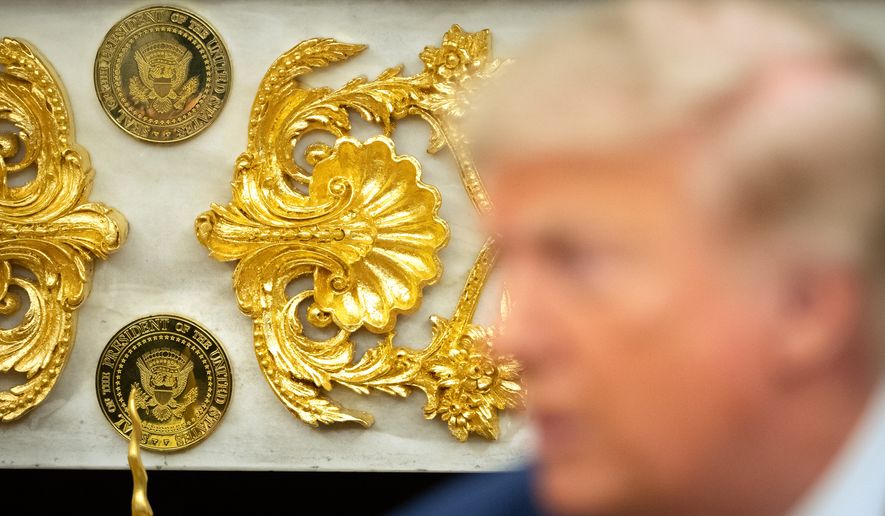

President Trump is reshaping the White House and the nation’s capital at a blistering pace, cementing a physical legacy as he faces his final years in power, having dominated U.S. politics for a decade.
His attempt to beautify the People’s House and Washington mirrors his career as a real estate tycoon who transformed landscapes.
It also reflects the image-conscious leader’s drive to be remembered when he no longer directs public policy and global affairs.
People were interested in these podcasts
“Buildings and monuments are not subject to repeal,” said Ross Baker, a distinguished professor emeritus of political science at Rutgers University. “He’s betting that the gilding of the city is not easily erased, not quickly or easily at any rate.”
Paramount among the changes is Mr. Trump’s drive to build a grand ballroom in place of the East Wing, which he razed.
The project faces legal challenges and will not be completed before the end of Mr. Trump’s term, but it will stand as a visual emblem of his presidency.
“I always said I was going to do something about the ballroom because they should have one,” Mr. Trump said last year. “So, we’ll be leaving it. It’ll be a great legacy project, and I think it’ll be special.”
During a dinner with ballroom donors, Mr. Trump placed himself in a line of former presidents who transformed the White House grounds.
He pointed to James Monroe, who installed the South Portico, and Andrew Jackson, who built the portico on the north side. Theodore Roosevelt added the West Wing, and Harry S. Truman added the balcony that now bears his name.
Mr. Trump is also making major changes to official maps, renaming the Gulf of Mexico the Gulf of America and Lake Ontario Lake America.
He has spoken of annexing Canada, Greenland and Venezuela as U.S. states or territories.
Further, the Treasury Department announced a plan to put Mr. Trump’s signature on paper money, and the U.S. Mint rolled out a $1 gold-finish coin featuring Mr. Trump’s face to mark America’s 250th birthday.
Mr. Trump, a former reality TV star, is keenly aware of the power of visual symbols, and his push to leave a lasting imprint on maps and monuments coincides with the waning years of his ability to reshape the country and world as president.
Since descending his golden escalator in 2015, he has dominated U.S. discourse like few other politicians in history.
Now, he is battling approval numbers stuck in the low 30s and a recalcitrant Iranian regime that seems intent on dragging out another Middle East war.
Canada recently walked away from trade negotiations with the U.S., betting that time in the tariff penalty box is worth it for the sake of its national pride.
Also, Mr. Trump recently turned 80, so thinking about posterity is normal, said Craig Shirley, a presidential historian and Ronald Reagan biographer.
“When a man gets to that age, and he reaches the pinnacle of success, he wants to be well thought of, and that goes for all presidents,” Mr. Shirley said.
Democrats have challenged the ballroom in court, saying it required congressional approval, and have warned that private donors will seek special favors after funding the project.
They also object to the project on principle, saying it was designed to glorify the current president.
“This ballroom is no gift to the American people — it’s congressional Republicans’ personal gift to Donald J. Trump,” Senate Minority Leader Charles E. Schumer, New York Democrat, said in a floor speech this year.
Mr. Trump is forging ahead with construction and is not stopping with the ballroom.
He installed large flagpoles on either side of the White House, renovated the Lincoln Bathroom with marble**, and** paved over the grass in the Rose Garden.
Beyond the White House, Mr. Trump is beautifying parts of the nation’s capital, restoring defunct fountains and launching a legally contested effort to restore the Reflecting Pool in front of the Lincoln Memorial.
The administration is engaged in a legal battle to affix Mr. Trump’s name to the John F. Kennedy Center for the Performing Arts, which is undergoing renovations at Mr. Trump’s direction.
Leaving a lasting impact through legacy projects is not unusual for presidents, especially for those who leave an imprint on U.S. culture.
Mr. Shirley said the nation’s capital was named for George Washington when the Founding Father was alive, and entities were named after Kennedy after his assassination, meaning renamings can occur during a person’s time in office or later.
Prominence and popularity are also factors. The airport in West Palm Beach, Florida, was renamed after Mr. Trump because he is well-liked by locals.
“There’s certainly power to being popular. Not much named after Richard Nixon, right? There’s not much named after James Buchanan,” Mr. Shirley said.
The White House said Mr. Trump will go down in history as “the most successful and consequential president in our lifetime” and that his beautification projects will leave the White House and the nation’s capital in “excellent condition” for generations.
“His successes on behalf of the American people will be imprinted upon the fabric of America and will be felt by every subsequent administration that comes after him,” White House spokesman Davis Ingle said. “Thanks to the Builder-in-Chief, no other president has done more to beautify our nation’s interior than President Trump.”
Some of Mr. Trump’s projects are divisive.
Public opinion polls show the American public is not enthusiastic about Mr. Trump’s plan to install a 250-foot-tall arch at Memorial Circle, on the Virginia side of the Arlington Memorial Bridge, in the style of the Arc de Triomphe in Paris.
If built, however, the project could outlast the ebb and flow of popular opinion.
Decades ago, there was a campaign to tear down the White House-adjacent Executive Office Building as a “Victorian monstrosity,” Mr. Baker said.
“A 200-foot-tall arch,” he said, “is not easily torn down even if people hate it.”
Contact the author

Please read our comment policy before commenting.