


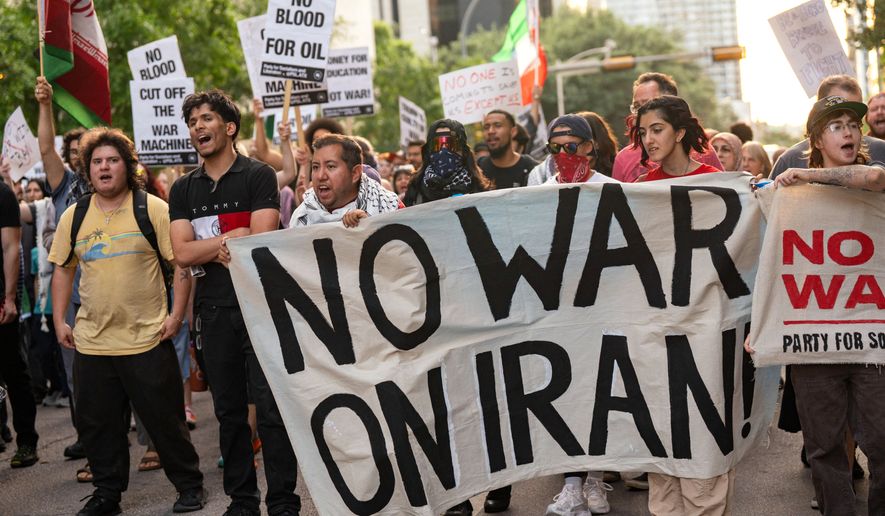

Republicans Michael Whatley in North Carolina, Mike Rogers in Michigan and Ken Paxton in Texas have all stuck with their support for the U.S. war with Iran, which polls show is opposed by a majority of Americans.
Still, these candidates are not talking much about the conflict on the campaign trail. Instead, they are leaning hard into crime and immigration and are warning that President Biden created America’s cost-of-living woes and Democrats would make them worse.
Voters, though, are feeling the effect on oil prices in real time as the war drives up prices at the gas pump and in the grocery store.
People were interested in these podcasts
“The war in Iran is an economic issue,” said Paul Shumaker, a North Carolina Republican strategist and pollster. “It is not a war. It is an economic issue. That is how voters see it.”
Gas prices have surged since President Trump ordered strikes against Iran in late February, triggering a standoff in the Strait of Hormuz, a critical passageway for oil tanker traffic.
Iran’s attacks on oil tankers in the strait have kept crude oil prices above $90 a barrel and pushed the national average for regular gasoline above $4 per gallon every day in August.
That was the highest price for gasoline on record for August, according to AAA. However, adjusted for inflation, gasoline prices were higher in August 2012 at roughly $5.08 per gallon — a year when tensions with Iran also helped rile oil markets.
For voters, today’s high gas prices stand in sharp contrast with before the conflict, when gas was less than $3, and Republicans were pointing to falling prices as proof that they and Mr. Trump delivered on promises to lower costs after years of reckless Democratic policies.
Mr. Trump’s approval rating is now around 35%, down in part because voters disapprove of the war.
Midterm elections are often presidential referendums. That does not bode well for Republicans this year.
“You kind of have this environment that is intrinsically built against the president and the war. The issues it is causing for the economy is certainly not helping his cause,” said J. Michael Bitzer, a professor of politics and history at Catawba College in Salisbury, North Carolina.
The fight with Iran has dragged on longer than expected.
Mr. Trump predicted in March that defeating Iran would take a few weeks. The conflict just crossed the six‑month mark.
A recent Reuters/Ipsos poll showed just 31% of Americans back strikes against Iran, down from 37% in March. More than 80% expect the war to “go on for an extended period of time.”
That complicates Republicans’ argument that the administration inherited an economic mess from Mr. Biden and that Democrats will make things worse if they regain power in Congress.
Mr. Whatley has tried to shift the conversation, warning that his Democratic rival, former Gov. Roy Cooper, wants to unwind Mr. Trump’s policies that succeeded in securing the border and stemming the flow of illegal immigrants, drugs and human trafficking.
“In this election, there is no area where you will see bigger consequences than what is going to happen in terms of illegal immigration,” Mr. Whatley said at a recent campaign stop with Paul Perez, president of the National Border Patrol Council, and people whose family members were killed by illegal immigrants.
Mr. Whatley highlighted how Mr. Cooper vetoed three Republican‑backed bills that would have required local law enforcement and county sheriffs to comply with U.S. Immigration and Customs Enforcement detainers.
In Michigan, Mr. Rogers has made similar arguments, blaming Democrats for the state’s high utility and auto insurance bills. He has also talked about securing the border, keeping fentanyl off the streets and getting “trans flags out of our classrooms and American flags back in.” He dinged his opponent, Democrat Abdul El‑Sayed.
“Conman Abdul can’t answer the question about gender transition surgeries for children because he supports it,” he said. “Conman Abdul can’t answer a question about letting violent criminals and sex offenders out of our prisons because he believes it.”
Like Mr. Rogers and Mr. Whatley, Mr. Paxton did not mention the war at a recent campaign stop. He outlined his plan for tax credits, and he cast Democratic rival James Talarico as a far‑left figure who supports more taxes and biological boys playing in girls’ high school sports.
“James Talarico is the most radical Democrat ever to run statewide in Texas,” the Texas attorney general said. “Everything I just laid out was money in your pocket. His entire record takes it out.”
Democrats are keeping the economic fallout from the war front and center.
Mr. Cooper said the conflict lacks a strategy and is sending prices soaring. He said military families are worried about loved ones overseas and facing the “brunt of the rising prices in their own military families.”
In Michigan, Mr. El‑Sayed and his allies argue — echoing criticism from former Rep. Marjorie Taylor Greene and other former Trump supporters — that billions of dollars spent overseas should instead go to schools, roads, healthcare and affordability challenges at home. “We are now in a war with Iran that’s raising the price of everything from our groceries to our gas,” he said.
In Texas, Mr. Talarico has tied rising fuel, supply‑chain and consumer costs directly to the conflict with Iran.
“The people who started this war in Iran don’t have to worry about the price of gas every day,” he said. “But we do.”

Please read our comment policy before commenting.