
The true ‘cost-exchange ratio’ of U.S. air defense
Rep. Ted Lieu, California Democrat, recently quipped that U.S. air defense strategy in the Iran war is akin to “throwing Ferraris at Frisbees.”


The new Administration sees advanced threats from China and Russia as a top priority and has issued an executive order, Golden Dome for America, to address. The Reagan era "Star Wars” program is becoming a reality as faster, more maneuverable hypersonic weapons pose dangers at home and abroad. The Threat Status team takes a deeper look at the technology, the policy and the strategy needed to outpace our adversaries.
Rep. Ted Lieu, California Democrat, recently quipped that U.S. air defense strategy in the Iran war is akin to “throwing Ferraris at Frisbees.”

The global engagement advocates at the Atlantic Council are pressing for clarity on the Pentagon’s Golden Dome initiative, which they say is a program in search of a definition.


The accelerating race among global powers for dominance in space will hang in the backdrop next week as leaders from across the space industry and the U.S. military converge on Colorado for the 2026 Space Symposium.

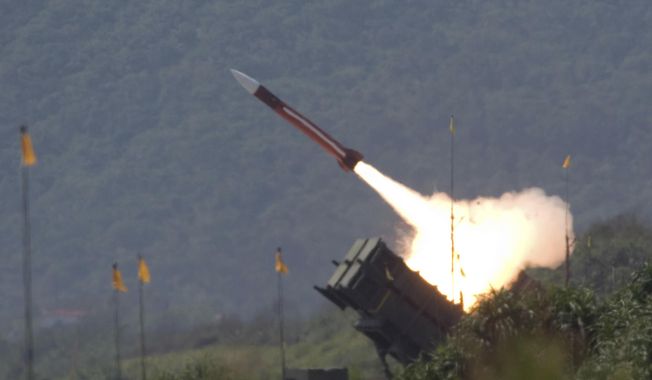
The Pentagon has awarded a $4.76 billion contract to defense contractor Lockheed Martin to rapidly build up stockpiles of the Army’s most advanced terminal anti-missile interceptors, a weapon depleted during heavy use in the war against Iran.

Cliff Beek, an entrepreneur and leader in the futuristic world of space infrastructure, joins the show for an eye-opening discussion on the fast-evolving intersection between space and business.
The Trump administration will spend nearly $39 billion in the next several years on rapidly building the first parts of the new Golden Dome nationwide missile defense system.
Senior defense industry officials say bureaucratic barriers, not technological challenges, are standing in the way of a fully integrated missile defense system.

Liz Martin, the managing director and general manager for global defense at Amazon Web Services, joins the show to talk about the company’s work with the U.S. military and competition versus cooperation among defense companies.

In a hypothetical nuclear war involving Russia, China and the United States, the island of Greenland would be in the middle of Armageddon.

President Trump on Wednesday said the U.S. must take control of Greenland to build its Golden Dome missile-defense system and become an effective deterrent to China and Russia, and anything less is “unacceptable.”
NATO needs the U.S. to take control of Greenland to be an effective deterrent to China and Russia, and anything less is “unacceptable,” President Trump said Wednesday.

National Security Correspondents John Seward and Bill Gertz break down the key takeaways from the 2025 Reagan Defense Forum.

It’s gone from science fiction to a matter of serious military planning in a remarkably short time.
President Trump’s “Golden Dome” czar has revealed that he has conducted private discussions with more than 300 companies to develop the secretive missile defense shield planned to protect the entire U.S. homeland by mid-2028.
President Trump’s Golden Dome czar says he has held “one-vs.-one” talks with more than 300 private companies in recent months to hash out the secretive architecture of the futuristic missile defense shield that the administration is determined to put into operation over the entire U.S. homeland by mid-2028.
Global demand for arms in an increasingly fractious world and an alarmingly depleted U.S. stockpile of long-range weapons are driving a dramatic surge in the American defense industry’s production of rockets and missiles.

China’s military has deployed multiple space warfare systems capable of destroying and disrupting U.S. satellites vital for military operations, while the U.S. Space Force so far remains constrained from developing its own space weapons in response, according to a congressional report made public Tuesday.

After a brief run on the big screen, Netflix brought Academy Award-winning director Kathryn Bigelow’s “A House of Dynamite” to the small screen on Oct. 24.

The race to develop nuclear propulsion isn’t just about reaching Mars; it’s also an important next step in our battle for space dominance.

The Threat Status team takes a deeper look at what the defense industry is doing to meet the demand to keep our soldiers, sailors, airmen and Marines equipped with the latest technology.
The head of President Trump’s Golden Dome missile defense program gave a classified briefing to the Senate Armed Services Committee last week that described the secretive architecture of the project, The Washington Times has learned.

Current communication systems relied upon by U.S. war fighters are too “old” and “outdated,” according to Secretary of the Army Daniel P. Driscoll, who says a concerted push is underway to accelerate private industry’s delivery of advanced technology and the Army’s acquisition process.

The Threat Status team from The Washington Times goes behind the scenes of AUSA 2025, exploring the themes and the tone being set for tech advancements in the U.S. military.

New self-destructing drones, developed by U.S. and Israeli military contractors, will soon be in the hands of Army soldiers.

Guy Taylor, National Security Editor with Threat Status at the Washington Times and John T. Seward, lead NATSEC Tech correspondent at Threat Status, with the themes they see across the 2025 AUSA conference.

Army Lt. Gen. Chris Mohan, the deputy commanding general and acting commander of Army Materiel Command, explains how the Army plans to use 3D printing to manufacture drone bodies and print drone replacement components near the battlefield. From the floor of the Association of the United States Army convention in Washington.

It’s an urgent mission for the Pentagon and its defense industry partners: Build cost-effective tools — lots of them — to counter the increasingly cheap and lethal tactical attack drones wielded by America’s adversaries abroad or terrorists targeting events at home.

Army Secretary Daniel P. Driscoll slammed the defense acquisition system on Monday, saying it prioritizes the desires of government bureaucrats and defense lobbyists over the needs of the American soldier.

It’s no longer a given that the U.S. and its allies will control the skies with ease in conflict. In the 21st century, gaining and maintaining air superiority will require a combination of cutting-edge tactical drones, surveillance aircraft powered by artificial intelligence, multimillion-dollar fighter jets and stealth bombers.

Germany’s Munich Airport was forced to close for seven hours on Thursday evening following a string of drone sightings, making it the latest European airport to halt business over drone incursions.

Tomer Malchi, founder and CEO of the Israel-based company Asio, joins the show to discuss soldier-borne technology, 21st-century combat, drones, and much more.
Debate over the cost and feasibility of President Trump’s planned Golden Dome missile defense system has raged despite the White House’s insistence that the plan is affordable and will be completed by 2028.

The U.S. Space Force opened competition last month for companies to design a compact radio-frequency communication terminal aimed at supporting President Trump’s Golden Dome missile defense system.
Russian President Vladimir Putin voiced alarm over President Trump’s plan to deploy space weapons as part of a missile defense shield called Golden Dome and expressed concerns that the defenses will neutralize Moscow’s offensive nuclear forces, according to Russian state media reports.

From directed energy weapons to cutting-edge electronic warfare and new computerized fire control systems that improve the effectiveness of a soldier’s AR-15 rifle, the global defense industry is developing new, creative and affordable ways to combat the small attack drones that have revolutionized modern warfare.

Guy Taylor and Ben Wolfgang discuss the latest tech, companies, and collaborations at AFA 2025 in National Harbor, MD.

Wesley Sparks, Director of Business Development at Honeywell explains how the company aims to provide power, thermal management, and energy storage for directed-energy weapons. From the floor of AFA 2025 in National Harbor, MD.
President Trump adopted a new policy for aggressively developing advanced technologies, including artificial intelligence and quantum communications, according to a White House memorandum sent to all federal agencies on Monday.
Maintaining American dominance in space requires a renewed focus on capabilities delivery, the U.S. Space Force’s chief of space operations said this week at the annual Air, Space & Cyber Conference.

Key leaders from across the U.S. military and defense industry will gather next week just outside Washington to help cement America’s “decisive edge” over its adversaries in the air, space and cyber domains, at a moment when growing threats and raging conflicts around the world are colliding with unprecedented leaps forward in technology.

Rob Mitrevski and Tom Gould, executives with major defense company L3 Harris, join the show to discuss the Golden Dome missile shield.

The U.S. military is planning to add multiple nuclear warheads to aging Minuteman III intercontinental ballistic missiles to increase their deterrence firepower until the troubled Sentinel missile system can be deployed, Congress’ Government Accountability Office disclosed in a report made public Wednesday.

U.S. forces are vulnerable to drone swarms due to insufficient scale and urgency in efforts to meet the demand for affordable, precise drone and counter-drone systems, a new report says.
Defense firm Lockheed Martin this week announced a record-setting deal to provide nearly 2,000 Patriot air and missile defense interceptors and associated hardware to the Army.

Gallery: 102 Photos
Golden Dome for America. The Washington Times is joined by high-level U.S. government and defense industry leaders to look at the technology, the policy and the strategy needed to outpace our adversaries. Tuesday, May 13, 2025. Photo credit: Eleanor Kaufman / The Washington Times
